




Prefer spontaneous travel and making decisions on the go? We’ve got you covered with full support along the way. We’ll be in touch with you 24/7 to:
Find and book a great restaurant or tour along the route;
Help locate nearby service points, like water disposal or refueling stations;
Quickly adjust your route if you’re in the mood for new experiences.
With us, your journey will be easy, well-organized, and truly free.
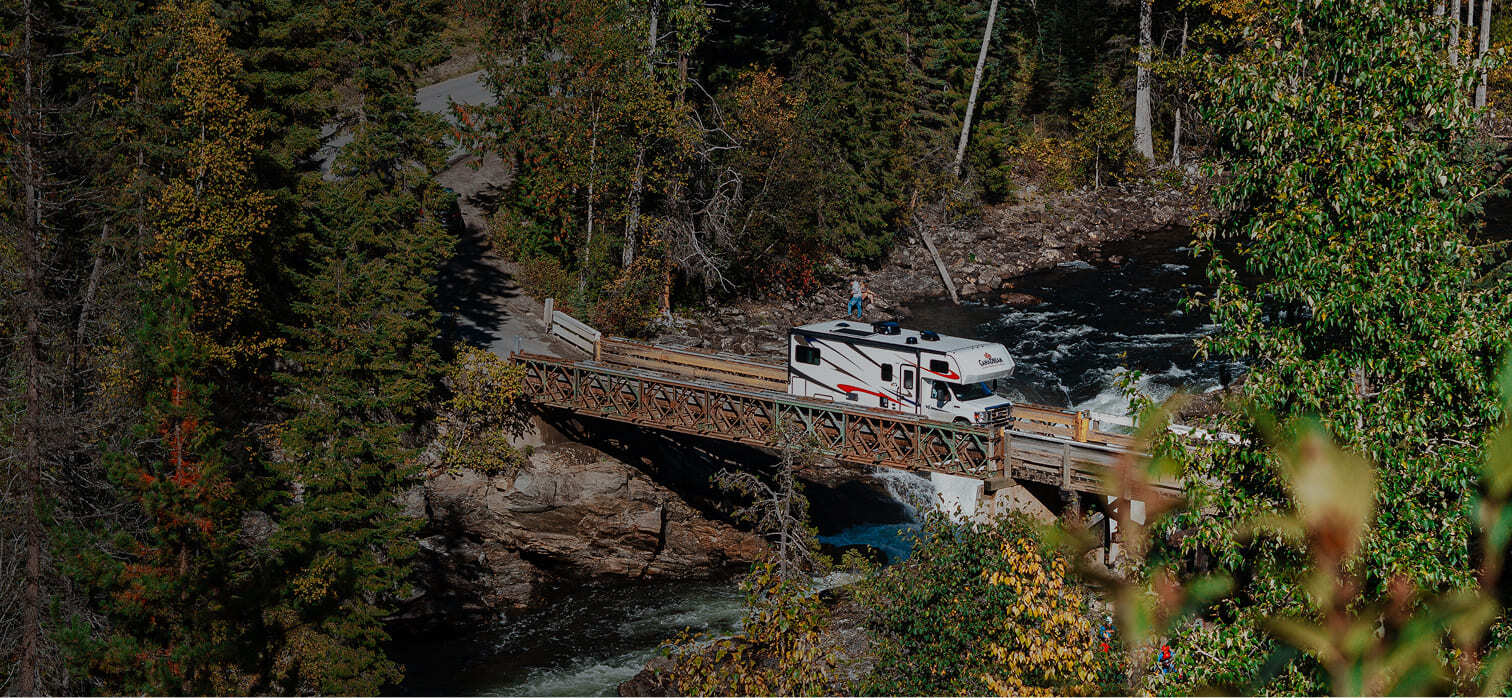
There is no hire desk inside the YVR terminal: most depots are about 30 minutes away. You collect the vehicle after a short transfer.

-
 Matching the vehicle to your trip. The team selects a motorhome to suit your dates, budget and group size.
- Reviewing the agreement. Specialists find additional charges and quote the full cost before payment.
- Overnight stops to suit the vehicle. The Great RV Trip support team checks the length and width against the pitch dimensions and helps book a campground.
- International experience. The company operates in more than 50 countries and holds a 4.7 rating on Trustpilot.
- Contact during the trip. The support team stays in touch throughout and gives you the contacts for the rental company’s breakdown service.
- A note on local terms: in Canada, motorhome hire is marketed as RV rental, and vehicles are classified as Class A, B, C and TC (Truck Camper, a camper unit in a pickup bed). A campervan may also be listed as a “camper van”. An RV park is the local term for a serviced pitch with electricity, water and a dump point, charged per night.
Why Vancouver works as a starting point, and where to collect
Rental depots are concentrated in Delta, Abbotsford and Vancouver. One of the larger ones sits 26 km from the airport and 32 km from the city centre. There is no transfer at that site, so a taxi costs around CAD 55 from the airport and CAD 70 from the centre. Another pick-up point is 15 minutes from YVR. Collection hours differ: 11:30–14:30, 13:00–16:00 and 08:30–15:00, and on Sundays collection runs until 13:00. The number of vehicle categories per station varies too: 7, 11, 4, 11 and 6. Handover takes about 60 minutes, so allow some margin on collection day.
Highways and bridges in British Columbia are free, with no tolls. Whistler is 120 km away on Highway 99 (Sea to Sky), about 1.5 hours of driving. Passengers on transatlantic flights, however, must spend their first night in a hotel: the vehicle is not handed over on the day you land. Some operators apply a stricter rule — if the total flight time exceeds 6 hours, including connections, that hotel night is compulsory. Your first day becomes a city day, not a mountain one.
Cost of motorhome hire in Vancouver (RV rental rates)
Rates by class
| Class | Rate per night | Scope |
|---|---|---|
| Class B (campervan) | CAD 112–230 | Economy 112.1 · B-DELUXE 134.5 · two-berth 155.8 · Camper Van 229.9 |
| Class C (coachbuilt with an over-cab bed) | CAD 81–214 | Economy 81.4 · C-Medium 138.9 · C-MEDIUM PLUS 146.9 · C-LARGE 151.2 · 199.2 · 213.6 |
| Truck Camper (TC) | CAD 134–192 | two-berth 134.1 · three-berth 159.5 · 192.0 |
| The market overall | CAD 45–450+ a day | aggregator floor, market ceiling |
| A typical campervan | around CAD 135 a day | aggregator |
| Trailers / motorhomes | around CAD 100 / 175–300 per night | private-owner segment |
The rate depends on the sub-class and the season, so the bottom of the range does not describe a typical vehicle. The spread within one class comes down to body size and date.
Kilometres are bought in packages
Unlimited kilometres are not the default in Canada: most offers carry a daily allowance, and you buy extra kilometres in packages. In the rental price cards a 100 km package costs CAD 43, 500 km — CAD 210, 1,000 km — CAD 399 per hire. Beyond the package a kilometre costs CAD 0.45, rising to CAD 0.47 in 2027; with some operators it is CAD 0.47 from the start. Unused kilometres are not refunded, so buy the package that matches your actual mileage. Some operators include unlimited kilometres and a free second driver. Unlimited kilometres sell at CAD 99 per night with a minimum charge of CAD 1,386.
Mandatory and additional charges
| Item | Amount |
|---|---|
| Preparation fee | CAD 100 per booking, mandatory; includes hoses, a full propane tank, a 15A cord, chemicals and levelling blocks |
| Convenience kit | CAD 100 per person; kitchen only — CAD 80 per hire |
| All-inclusive package | CAD 57 per night, minimum 5 nights |
| Fuel per litre | CAD 1.80–2.10 |
| Propane per trip | CAD 50–100 |
| Campgrounds | CAD 13–60 per night |
| Pet cleaning | CAD 200 per hire |
| Child seat | CAD 30–80 per hire |
| Generator | no charge for hours with some operators |
| Additional driver | free with some operators |
Deposits and excess
| Level | Refundable deposit on collection | Excess per incident | Package cost |
|---|---|---|---|
| Basic insurance | CAD 7,500 + tax | CAD 7,500 | included |
| Reduction package | CAD 750 + tax | CAD 750 | CAD 32 per night, maximum CAD 960 |
| Full waiver | CAD 100 + tax | CAD 0 | CAD 15 per night, maximum CAD 450 |
The booking deposit is charged separately: CAD 750 plus tax to confirm, with the balance taken 30 days before departure.
The minimum hire with large operators is 5 nights, and bookings are taken at least 5 working days ahead. For peak dates you book 2–4 weeks ahead; in the shoulder season 2–3 days is enough. Peak months cost 1.5–2 times more than the rest, and discounts start at 7 nights.
British Columbia charges GST at 5% plus PST at 7%, making 12% in total. In restaurants it is customary to leave 15–20% of the bill, as service is not included. Buying groceries in Metro Vancouver pays off: prices on the route are noticeably higher.
Types of motorhome and how to choose
| Format | Berths | Feature |
|---|---|---|
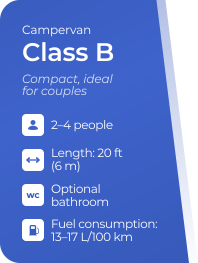
| Class B (campervan) | 2–4 | Pop-top roof, mini kitchen, sleeping places |
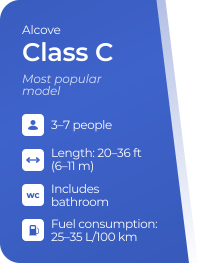
| Class C (coachbuilt) | 5–8 | Bed over the cab, kitchen, bathroom |
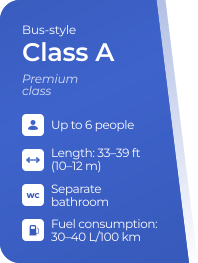
| Class A (integrated) | 3–8 | A single bus-style body |
| Truck Camper (TC) | 2–3 | A camper unit in a pickup bed, up to 5 seatbelts |
| Travel trailer | 2–6 | Needs a tow vehicle and a hitch |
Class C is a coachbuilt motorhome, not a semi-integrated one: the sleeping area sits above the cab. One format runs to 20 ft (6.1 m) with 4 berths. Some offers come with a built-in shower and toilet, others with made-up beds, a fitted kitchen and a bathroom with a shower. Some operators keep a wheelchair-accessible Class A in the fleet.
Seatbelt numbers and berth numbers diverge, so check them separately. Towing behind the motorhome is prohibited by some operators for insurance reasons, and off-road and non-public roads are off limits too. The electrics run on 30 AMP: the kit includes a cable with a 15A adapter, and the roof air conditioner works only on 30 AMP.
The logic is simple. A compact vehicle wins in town and on the coast; long highway runs call for a large Class C or a Class A; the island demands a margin on dimensions for the ferry; the mountains call for ground clearance.

Expert opinion
Evgeny Byakin
founder of Great RV Trip, who has personally driven 20,000 km along the Pan-American Highway through 13 countries
Choosing a motorhome in Vancouver starts with the dimensions, not the berth count. Pitches in the provincial parks are built to a specific length, and a large Class A simply will not fit. The ferry charges for every foot over twenty, so you measure the vehicle before you book. For mountain routes a compact Class B or a small Class C suits you. On long descents brake condition matters more than rated power: engine braking is more reliable than constant use of the brakes. Check seatbelts separately from berths.
Choose your RV type
Licence, age, insurance and deposit
An ordinary car licence, class 5 or equivalent, is enough; no separate category is needed for a motorhome. The physical card is mandatory: digital licences are not accepted. Foreign licences work in English or French; otherwise you need an International Driving Permit (IDP), valid only alongside your national licence. A licence issued in a non-Latin script makes the IDP compulsory. You also need a passport.
The minimum driver age is 21, with 23–25 for certain categories, and some operators set the minimum at 25 and ask for a good driving record. Most have no upper age limit. Some operators require at least 12 months of driving experience, and a few raise the minimum to 1–2 years.
The refundable deposit is held on the main driver’s credit card at collection, and not every operator accepts debit cards, so agree the payment method in advance. The protection package covers accidental damage and liability, but the insurance terms are worth reviewing before you sign. The deposit and insurance are where extra charges most often appear: paid options, higher deposits for foreign drivers and damage terms on return. Great RV Trip reviews the agreement and explains the deposit requirements before payment, so you know the full cost in advance.
Seasons and winter preparation
| Period | Months | What happens |
|---|---|---|
| High | July–August | peak prices, 1.5–2 times higher; book 2–4 weeks ahead |
| Shoulder | late May–June, September | lower rates; book 2–3 days ahead |
| Low | October–April | winter preparation, limited availability |
The coast is milder than the interior. Under the Environment and Climate Change Canada normals for 1991–2020 at the YVR station, the mean daily maximum in July and August is 22.4 °C, with a minimum of 13.9–14.0 °C. June gives a maximum of 19.6 °C and a minimum of 11.9 °C; September 19.1 °C and 11.2 °C. April brings 13.1 °C and 5.7 °C, October 13.5 °C and 7.0 °C. December and January hold around 6.6–6.8 °C by day and 1.2–1.4 °C at night, so a winter departure from Vancouver turns on snow at the passes rather than on frost.
Winter preparation changes life on board
Between 1 October and 30 April the vehicle may be switched to winter mode, depending on the temperature forecast for your collection date. The water system is shut off for that period, so there is no running water on board. Plan your nights at campgrounds with hook-ups (electricity, water and sewer connections) and toilet blocks that stay open year-round. Propane (bottled gas) burns faster on freezing mountain nights than in summer, so fill the tank with a margin.
Winter tyres: the British Columbia rule
Winter tyres or chains are required on designated highways from 1 October to 31 March, with the window extended to 30 April on certain routes. The requirement applies once you leave the Lower Mainland and the south-east of Vancouver Island: in many coastal areas winter tyres are not compulsory, but the Malahat falls inside the zone. A legal winter tyre carries the M+S or 3PMSF marking (the mountain-and-snowflake symbol) and at least 3.5 mm of tread. Chains on summer tyres do not substitute for winter tyres. Studded tyres are permitted from 1 October to 30 April.
Rental vehicles do not come with winter tyres or chains. Class C vehicles in the rental fleets run on M+S tyres, which meet the provincial minimum with 3.5 mm of tread, but the specification is worth confirming with the rental company before departure. Depot hours are seasonal too: from 1 October to 30 April, Monday to Saturday 08:00–16:00, closed on public holidays; from 1 May to 30 September, Monday to Sunday 08:00–17:00, open on public holidays.
One-way hire: Vancouver to Calgary
One-way hire between Canadian cities is permitted; between Canada and the USA it is not available. A trip into the USA in a hired motorhome is allowed at no extra charge, but you return the vehicle in Canada.
| Direction | One-way fee |
|---|---|
| Vancouver → Calgary / Edmonton | CAD 650, rising to CAD 725 in 2027 |
| Calgary / Edmonton → Vancouver | CAD 1,200 to CAD 1,550 |
| Other directions | CAD 1,100 |
The asymmetry is real: the return leg costs roughly twice as much. Vehicles accumulate in the west, so moving them back runs against the flow and costs more. The minimum hire period for one-way is longer than usual, and unlimited kilometres carry a minimum charge of 14 nights.
The fuel arithmetic favours Alberta: a litre there costs CAD 1.50–1.80 against Vancouver levels, so filling up before the provincial border saves a noticeable sum.
Vancouver Island
The island is reached by ferry to Victoria, and rental arrangements there are different. In Victoria the depot sits 25 minutes north of downtown, close to the airport and the ferry terminal, and the vehicles there are prepared for year-round use. In Nanaimo you pick up campervans for runs to Tofino, Ucluelet, Parksville and Campbell River. In Parksville, Qualicum Beach, Chemainus and Crofton, trailer delivery is common: the operator brings it to your booked pitch, levels it, connects it and takes it away at the end. That format does away with towing and dumping, but it needs a pitch with at least a 30 AMP hook-up.
Ferries and fares
BC Ferries runs from Tsawwassen to Swartz Bay and Duke Point, and from Horseshoe Bay to Langdale and Departure Bay. The Tsawwassen – Swartz Bay crossing takes 1 hour 35 minutes, with 10–17 sailings a day depending on the season; Horseshoe Bay – Langdale is shorter at 40 minutes. Add terminal time to the crossing.
| Item | At Terminal / Prepaid | Saver |
|---|---|---|
| Motorhome up to 20 ft (6.1 m), excluding driver and passengers | CAD 89.00 | CAD 34.00–84.00 |
| Each foot over 20 | CAD 8.00 | CAD 7.00 |
| Passenger aged 12 and over | CAD 21.00 | CAD 15.00 |
| Child aged 5–11 | CAD 10.50 | CAD 7.50 |
| Under 5 | free | free |
The fares run from 8 April 2026 to 31 March 2027, and a 5% fuel surcharge is added at payment. A vehicle counts as oversized above 7 ft (2.13 m) in height or over 20 ft (6.10 m) in length, which covers most motorhomes. The commercial fare applies above a registered weight of 5,500 kg or a width over 9 ft (2.74 m), so check a large Class A before booking.
Booking rules differ by route. On Horseshoe Bay – Langdale reservations are open, the bookable share has risen to about 70% of deck space with a plan to reach 80%, and unbooked space is still loaded in order of arrival. A “reservations sold out” notice does not mean there is no deck space: some places are released for drive-up traffic once check-in closes. On Horseshoe Bay → Departure Bay the rules are tighter: you book and pay in advance, drive-up and Reservation only fares have been withdrawn, and the booking window has been cut from two hours to 30 minutes. Check-in opens 120 minutes before departure and closes 30 minutes before. Propane is shut off on the ferry, and staying in your vehicle on the closed lower deck during the crossing is prohibited; upper-deck placement is not guaranteed.
The ready-made island route takes 10 days and covers 941 km, starting and finishing in Vancouver. Green Point Campground in Pacific Rim National Park Reserve has 94 drive-in pitches, 20 walk-in, a group site and an oTENTik (a tent–cabin hybrid); bookings go through Parks Canada.
Routes out of Vancouver
Duration:
Duration: 10 days
Duration:
Duration:

The region’s natural highlights: Tofino, Ucluelet, Pacific Rim, Campbell River, Whistler, the Okanagan, Garibaldi Provincial Park, Golden Ears and Alice Lake.
Expert opinion
Evgeny Byakin
travelling by motorhome since 2018
The main mistake on routes out of Vancouver is planning more than one park a day. A leg that looks short on the map stretches out in a motorhome: fuel stops, water, dumping and groceries eat up the time without you noticing. Plan one park a day and leave a margin for setting up the vehicle in the evening. That pace leaves room for short trails. Treat ferry crossings as a separate item, not part of the driving day. Experience with a large vehicle is built on flat legs, not on a switchback on day one.
Campgrounds, overnight stops and passes
Provincial parks: BC Parks
Bookings open on a rolling window 3 months before your arrival date. The transaction fee is CAD 6 per night per pitch, capped at CAD 18, plus tax; the call centre adds CAD 5, and a change or cancellation costs CAD 6. From 15 May 2026 non-residents of British Columbia pay a further CAD 20 on top of the base fee; children and youth are exempt. Residency is proved with a BC driver’s licence, a BC Services Card or a BCID. The peak period runs from 15 June to Labour Day: rates are higher at 59 high-use parks, while the base rates at the other 388 have not changed. A second vehicle costs 50% of the base fee, up to CAD 12 per night. There is no annual BC Parks pass.
National parks: Parks Canada
| Pass or fee | Price |
|---|---|
| Discovery Pass, annual | CAD 83.50 adult · CAD 71.50 senior · CAD 167.50 family or group of up to 7 in one vehicle |
| Pacific Rim, daily entry | CAD 12.25 adult · CAD 10.75 senior · CAD 24.50 family or group |
| Pacific Rim, annual pass for this park only | CAD 60.50 adult · CAD 51.50 senior · CAD 120.75 family or group |
| Green Point, per night | CAD 34 unserviced · CAD 40 with electricity · oTENTik CAD 147.50 |
| Backcountry | CAD 15 per person per night |
| West Coast Trail | CAD 208.50 per person per trip |
| Reservation fee | CAD 11.50 online · CAD 13.50 by phone |
Children aged 17 and under enter Canada’s national parks free. Park entry is charged separately from your pitch: the pass does not cover camping.
Garibaldi Provincial Park
The park is provincial, not national, so the Discovery Pass does not apply here. In summer 2026 a free day-use vehicle pass is required at three trailheads, including Diamond Head and Rubble Creek. With an overnight booking the day-use pass is not needed.
Overnight stops in town and on Crown land
An oversized vehicle may stand on a street for up to 3 hours between 06:00 and 22:00, and between 22:00 and 06:00 it must be moved. Pay parking runs from 09:00 to 22:00 daily, including public holidays; that is a separate rule, not tied to the oversized-vehicle limit.
Crown land (publicly owned land) falls under the Permission policy: anyone may camp for up to 14 consecutive calendar days. The days count cumulatively unless you, your vehicle and your equipment are all absent from the site for at least 72 consecutive hours. The permission is open to Canadians and non-Canadians alike, and no application, fee or notification is required. It does not apply inside parks and protected areas, Wildlife Management Areas, municipal boundaries, leased or federal land, or in closed areas and application-only areas. Permanent structures are prohibited, and you take your rubbish with you.
Dump stations (chemical waste disposal points) operate at Capilano River RV Park in West Vancouver and at BC Parks sites, while Brownsville RV Park in Surrey offers a free seasonal dump point on the return run along Highway 17. At the Bridgeport Station park-and-ride, check the height clearance and the oversized-vehicle rules before entering.
The Great RV Trip team helps book an overnight stop to suit the vehicle’s dimensions and quotes the full cost in advance, so nothing is added on site.
Driving, parking and safety
Vancouver’s city speed limit is 50 km/h unless a sign says otherwise. Neighbourhood Slow Zones have a 30 km/h limit: the programme began in February 2026 in six areas, with 25 zones planned over three years.
Limits on the highways differ by corridor. Highway 99 from Horseshoe Bay to Squamish is limited to 80 km/h, Squamish to Whistler to 90 km/h, and Whistler to Pemberton back to 80 km/h. The Coquihalla (Highway 5) from Hope to Kamloops allows 120 km/h, while Highway 3 from Hope to Coquihalla is limited to 110 km/h. On the Trans-Canada, the Whatcom Road – Hope section carries 100 km/h, Boston Bar – Jackass Mountain and Tobiano – Savona carry 90 km/h, and Salmon Arm – Revelstoke and Revelstoke – Golden carry 100 km/h. On the island, Highway 19 from Parksville to Campbell River is limited to 110 km/h, dropping to 90 km/h further north.
The slow down, move over rule requires you to reduce to 70 km/h where the limit is 80 km/h or higher, and to 40 km/h where it is below 80 km/h. On a multi-lane road you move into another lane if it is safe. The fine is CAD 173 and 3 penalty points. The rule covers not only emergency services but also road crews, tow trucks, utility workers and land surveyors.
You pay for parking through PayByPhone or HotSpot. Coins have not been accepted since 27 April 2026. The city’s meters have no QR codes, so any QR sticker is fraudulent. Fill the water tank and the propane tank before heading into the mountains. Set the satnav for the vehicle’s height: city tunnels and underground car parks have height restrictions. Bears live in these forests, so the pitch must stay “bare”: keep food and rubbish in the vehicle or in sealed containers while you sleep or step away.
Apps
You pay for city parking through PayByPhone and HotSpot.
Provincial parks are booked at camping.bcparks.ca, national parks through the Parks Canada Reservation Service.
DriveBC reports road conditions, roadworks and closures.
BC Ferries gives schedules and ferry bookings.
iOverlander helps you find legal overnight stops, and GasBuddy compares fuel prices.
FAQ: RV rental in Vancouver
Conclusion
A motorhome trip out of Vancouver frees the route from a timetable: your bed is not tied to a hotel, and the vehicle stays wherever evening finds you. The day shapes itself: breakfast by the water, a leg along the highway, an evening at a campground. It looks simple until the contract comes up: one unread clause about kilometres, the deposit or the preparation fee eats the whole saving on hotels. Great RV Trip specialists review the contract terms before payment and quote the full amount in advance, so you know the price before collection and the budget stays predictable to the end of the trip.

E-mail: info@greatrvtrip.com


Contact us
Address:
2093 PHILADELPHIA PIKE #7170
CLAYMONT, DELAWARE 19703, USA
© GREAT RV TRIP, 2017–2026
Motorhome travel agency
Let's go on an adventure!
We use cookies and similar technologies to improve your browsing experience, analyze site traffic and serve targeted advertisements.
For more details, read our Privacy & Data Protection Policy and Cookies Policy.