




Prefer spontaneous travel and making decisions on the go? We’ve got you covered with full support along the way. We’ll be in touch with you 24/7 to:
Find and book a great restaurant or tour along the route;
Help locate nearby service points, like water disposal or refueling stations;
Quickly adjust your route if you’re in the mood for new experiences.
With us, your journey will be easy, well-organized, and truly free.
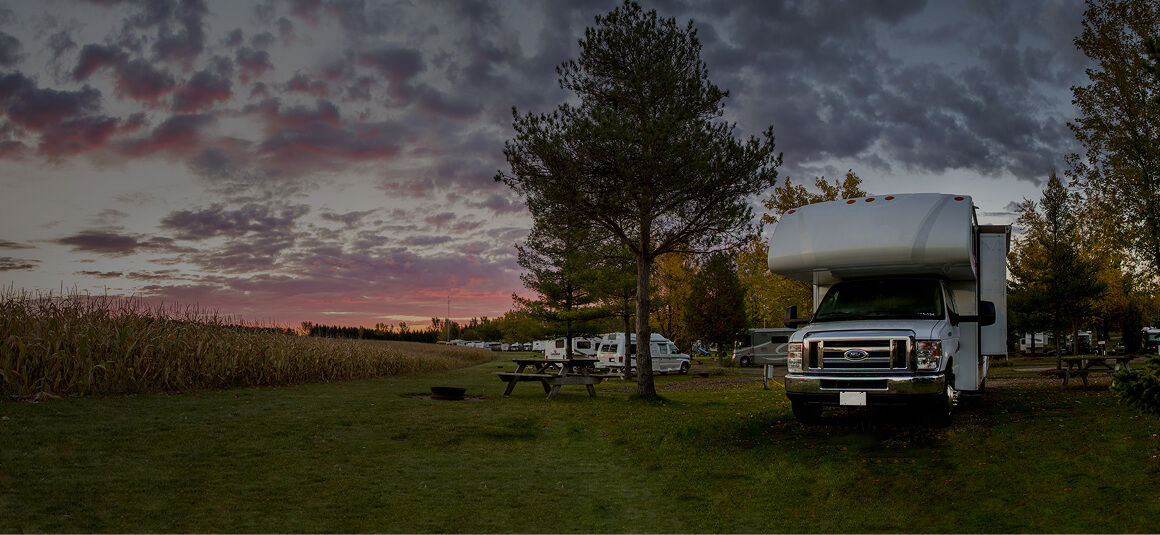
The campervan depot is in Nepean, and the rental company’s service centre is in Carp. Some offers include a meet-and-greet at Ottawa airport (YOW).

-
 Matching the vehicle to the trip. The team matches a motorhome to your dates, budget and group size.
- Contract review. The company’s specialists explain the mandatory fees and quote the full cost before payment.
- An overnight stop to fit the dimensions. The support team checks the vehicle’s length and width against the pitch dimensions and helps you book a campground (a campsite).
- International experience. The company works in more than 50 countries and holds a 4.7 rating on Trustpilot.
- Contact on the road. The support team can be reached throughout the trip and gives you the contact details for the rental company’s breakdown service.
- A note on local terms: in Canada, motorhome hire is listed as RV rental. A Class B campervan is a converted panel van, a Class C motorhome is coachbuilt with an over-cab bed, and a travel trailer is a trailer that needs a tow car. A campervan may also appear as a camper van. An RV park is the local name for a serviced pitch with electricity, water and dumping, charged per night, while hook-ups are the electricity, water and sewerage connections.
Why Ottawa Works as a Starting Point
The capital sits on the Ontario–Quebec border, so one trip covers two provinces with different rules. The Rideau Canal has been on the UNESCO World Heritage list since 2007 and remains the oldest continuously operating canal system in North America. Gatineau Park is the capital region’s conservation park, covering more than 361 km² and managed by the National Capital Commission. It is the second most visited park in Canada, and it is not a national park: the Parks Canada pass does not apply here. The park has around fifty lakes and two historic official residences. For a day out you can choose Meech, Pink, Philippe and La Pêche lakes, Lusk Cave, Luskville Falls, the lookouts, the Mackenzie King estate and the Carbide Willson ruins. Routes start from the Visitor Centre and Relais plein air. Between Fall Rhapsody in autumn and winter the park quiets down: the transition period is left to the wildlife to rest and prepare for the cold.
Algonquin is an Ontario provincial park of 7,635 km², established in 1893. The developed part runs along the Highway 60 corridor for 56 km, with 8 campgrounds and 14 interpretive trails. The interior lakes are reachable only by canoe or on foot: there are no roads to them. The park runs a Visitor Centre, a Logging Museum and an art centre; the educational Discovery Program takes place there, and in autumn the park publishes a colour report. Park Bus serves the park, so you can leave the vehicle on your pitch instead of driving it to every trailhead. Day-use zones stay open year-round, while each campground keeps its own dates. The service area for trailer and motorhome hire covers Ottawa, Kanata, Barrhaven, Orléans and Gatineau.
The Cost of Motorhome Hire in Ottawa
Rates by Class
A typical night in Ottawa costs CAD 110–220, while the full market range runs from CAD 60 to CAD 549. The market average is CAD 168 per night.
| Format | Rate per night | What the vehicle is |
|---|---|---|
| Campervan (Class B) | around CAD 195 | a panel van with a kitchen and berths |
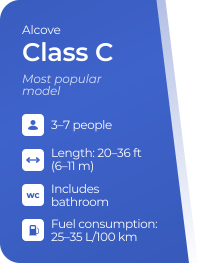
| Class C (coachbuilt) | CAD 199–250 | over-cab bed, kitchen, toilet and shower |
| Trailers | CAD 62–159 | from a compact teardrop to a bunkhouse model; a tow car is needed |
The rate depends on the format and the season, so the bottom of the range does not describe a typical vehicle. CAD 62 gets you a teardrop trailer, and you need your own tow car for it. Some Class C motorhomes are priced both below and above the typical figure: offers appear at CAD 195 and CAD 275 per night. Format affects the price more than the choice of rental company does. Between a trailer at CAD 62 and a coachbuilt at CAD 275 the difference is more than fourfold, so you choose the class before the company.
How the Mileage Allowance Builds Up
The rate includes 200 km for every paid night, and the allowance builds up across the whole trip rather than resetting each morning. A campervan hired for 7 nights gets 1,400 km, which you can spread across the route as you like. A kilometre beyond the allowance costs CAD 0.65 if you have not bought extra kilometres in advance. Packages and unlimited mileage are sold separately.
Mandatory and Additional Fees
| Item | Value |
|---|---|
| Camping essentials | CAD 195 one-off before tax; cleaning, kitchen kit, towels, stove fuel, coffee or tea, bags, soap, sanitiser, bedding |
| Booking essentials | a percentage of the base rate, capped at CAD 99 |
| Fuel | regular unleaded; return with a full tank, otherwise refuelling plus CAD 50 |
| Smoking inside the vehicle | CAD 1,000 plus replacement of parts |
| Dog | a cleaning surcharge; cats are not accepted |
| Late return | CAD 200 per hour |
| Fines and tolls | borne by you; if the rental company pays them, CAD 50 is added |
| Extra adult on the pitch | CAD 6 plus HST per person per day |
| Extra vehicle on the pitch | CAD 6 plus HST per vehicle per day |
The kitchen kit and bedding are part of a mandatory paid fee, not of the nightly rate. The two fees add at least CAD 195 to the bill, and booking essentials can add up to CAD 99 on top, so compare the nightly price with them included. Ontario applies HST at 13%, a single harmonised tax made up of a 5% federal share and an 8% provincial share. In restaurants it is customary to leave 15–20% of the bill; service is not included.
Types of Motorhome and How to Choose
| Format | Berths | Feature |
|---|---|---|
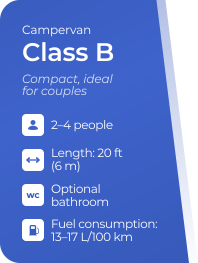
| Class B (campervan) | 2 or 4 | Two models: one queen bed or two in a bunk arrangement; rear-wheel or all-wheel drive |
| Class C (coachbuilt) | by model | Over-cab bed, kitchen, toilet and shower |
| Travel trailer | by model | Some trailers come with bunk beds; a tow car and a coupling are needed |
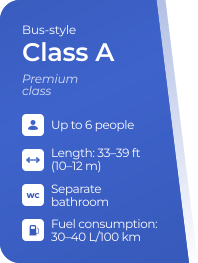
The campervans are built on a Ford Transit with an automatic gearbox and a reversing camera. There is no toilet or shower in the standard vehicles: the Deluxe AWD model with a portable toilet is available only in Calgary and Vancouver. Espar heating runs off the fuel tank and the battery. The electrical system consists of two AGM batteries of 100 Ah each and a 100 or 280 W solar panel, with charging from the chassis; that gives about four days without a hook-up. Below −10 °C you plan for a pitch with a 110 V socket in advance.
Towing behind the campervan and going off-road are both prohibited; the stove is not used inside, and you do not climb on the roof. A trailer needs a car with a suitable towing capacity and a coupling, so without a tow car of your own the format does not work. The number of seatbelts and the number of berths are not the same, so check them separately. The logic is simple: for the city and short drives you take a compact vehicle, for long hauls a Class C, and on a limited budget a trailer with delivery.

Evgeny Byakin
Founder of Great RV Trip, who has personally driven 20,000 km along the Pan-American Highway through 13 countries
In Ottawa the choice is more often between two campervan models than between classes. Look at who is travelling: two adults are fine with one bed, a family with children needs both bunks, and extra berths cost the same as the ones you use. The second question is the bathroom. Without a shower your route is tied to campgrounds with a toilet block, and that changes where you can overnight more than vehicle length does. The third is the tow car: without one the budget trailer option falls away, and the choice narrows to a compact or a coachbuilt.
Choose your RV type
Licence, Age and Insurance
An ordinary car licence of class G or its equivalent is enough; no separate category is needed for a motorhome. Learner’s permits, early graduated licences and novice 'N' licences are not accepted. A licence issued outside Canada, the USA and Europe may require an International Driving Permit (IDP), and it is valid only together with your national licence.
The minimum age for campervans is 25. The rental company also requires a good driving record.
Insurance comes from one of three sources: a personal policy covering cargo van hire, travel insurance, or the rental company’s protection package. In the private segment the package covers accidental damage and includes 24-hour roadside assistance. The insurance terms are worth reviewing before you sign, and the payment method is agreed in advance.
Booking, Deposits and Cancellation
You pay in full at the time of booking, and international cards may carry a 3% fee. The minimum hire is 5 nights, and bookings must be made at least 14 days before the trip. Collection is after 12:00, early collection is available as a paid option, and you can return the vehicle until 23:59 on the last day at no extra charge.
There are two deposits, and they are different payments. The refundable security deposit for campervans is CAD 1,000 or CAD 5,000 depending on the level of cover: it is charged up to 7 days before collection and refunded within 7 days of return, provided the vehicle is intact, the tank is full and the contract terms have been met. In the private segment the deposit is held on the main driver’s credit card, and the amount is quoted as a range of CAD 750–1,500.
Cancellation Depends on the Season of the Trip
| Trip between 1 May and 31 October | Refund |
|---|---|
| more than 60 days before collection | full, minus a CAD 150 admin fee |
| 30–59 days | 50% |
| 14–29 days | 20% |
| 13 days or fewer | 0 |
| Trip between 1 November and 30 April | Refund |
|---|---|
| more than 14 days before collection | full, minus a CAD 150 admin fee |
| 4–13 days | 50% |
| 72 hours or fewer | 0 |
A one-off change of dates or a swap of model is possible more than 30 days before collection, subject to availability. You pay any upward price difference, but a downward difference is not refunded. The private segment has a different window: a full refund within 24 hours of the owner confirming the booking.
Breakdown Assistance
Roadside assistance runs 24 hours a day and covers a wheel change, fuel delivery, a lockout and towing. When equipment inside the vehicle fails, the rental company first tries to fix it over the phone, and if the fault can be put right on site and a network point is within 200 km, a technician comes out. For a serious breakdown you get a replacement motorhome if one is available. Incidental expenses during the downtime are borne by you. For damage over CAD 2,000 a police report is needed from the jurisdiction where the incident happened. Great RV Trip reviews the cancellation terms and the deposit requirements before payment, so the amount to be charged is known in advance.
Seasons and Climate
| Period | Months | Daytime maximum / minimum |
|---|---|---|
| High | June–August | 24.4–27.0 °C / 12.9–15.4 °C |
| Shoulder | May, September–October | 13.0–21.0 °C / 3.4–9.6 °C |
| Low | November–April | −5.5 to 11.3 °C / −14.3 to 0.5 °C |
The figures come from the Environment and Climate Change Canada climate normals for 1991–2020 at the Ottawa Airport station, 114 m. Monthly maxima in °C: January −5.5 · February −3.6 · March 2.4 · April 11.3 · May 19.6 · June 24.4 · July 27.0 · August 25.8 · September 21.0 · October 13.0 · November 5.8 · December −1.9. Minima: −14.3 · −13.2 · −7.1 · 0.5 · 7.5 · 12.9 · 15.4 · 14.3 · 9.6 · 3.4 · −2.4 · −9.6. Night frost is normal here: the mean January minimum is −14.3 °C.
Events are tied to the seasons: Canada Day falls on 1 July, Fall Rhapsody in Gatineau Park is in October, and Winterlude on the Rideau Canal is in February.
Winter Changes What You Need at a Pitch
The campervans in Ottawa are four-season vehicles, and Espar heating runs off the fuel tank. Below −10 °C a pitch with a 110 V socket stops being a convenience and becomes the way to keep the batteries charged. Mew Lake campground in Algonquin is open year-round, as is the park’s backcountry, the interior zones without infrastructure.
Winter tyres are not mandatory by law in Ontario. Quebec requires winter tyres from 1 December to 15 March inclusive and recognises the 3PMSF marking (the mountain-snowflake symbol) or studs; M+S alone is not enough. The fine is CAD 200–300. The requirement applies to vehicles registered in Quebec, including rental vehicles: a motorhome on Ontario plates is not covered. The vehicle’s winter equipment, and whether the requirement applies to it, are worth confirming with the rental company before departure, because winter tyres remain a safety matter on climbs and descents, not only a legal requirement.
Routes and One-Way Hire
Duration: 6–7 days
Duration: 6–8 days
Duration: 9–11 days
One-Way Hire Is Not Available to Every City
One-way hire between Canadian cities is allowed, but the list of cities is limited: Calgary, Edmonton, Moncton, Ottawa, Penticton, Toronto, Vancouver and Victoria. Halifax and Montreal are not on that list, so you cannot build a route finishing there. The standard one-way hire fee is CAD 899; relocation deals are published without the fee, within a limited date window and with mileage included.
A trip into the USA is allowed with no surcharge for crossing the border, but the vehicle is returned only in Canada. You need the entry documents, and the border-crossing conditions are confirmed before the trip.

Explore scenic lakes, forest trails and peaceful campgrounds in the Ottawa Valley and Algonquin Provincial Park.

Discover the Thousand Islands, explore Montreal and enjoy the natural beauty of the Laurentians and Gatineau Park.

Travel through Montreal to the Gaspé Peninsula, with spectacular coastal landscapes, dramatic cliffs and scenic trails in Forillon National Park.
Evgeny Byakin
Travelling by motorhome since 2018
The main mistake out of Ottawa is assuming the vehicle and the pitch are booked in the same window. You book the camper at least 14 days before the trip, but a provincial park pitch opens 5 months ahead, so plan the campsites first. Then comes the pace: one park a day, with time allowed for setting up in the evening. Two provinces mean two sets of rules, so cross the border with the requirements already understood, not sorting them out on site. Experience with a large vehicle is built on flat stretches, not on the first mountain section.
Campgrounds, Overnight Parking and Passes
Wesley Clover Parks Campground
The campground is 20 minutes from the centre, in the National Capital Greenbelt, and was formerly called Ottawa Municipal Campground. The 2026 season runs from 1 May to 13 October, and the pitches take motorhomes up to 45 ft (13.7 m).
| Pitch | Per night before HST | Per week before HST | Per month before HST |
|---|---|---|---|
| 50 AMP plus water | CAD 70.16 | CAD 422.10 | CAD 1,549.26 |
| 30 AMP plus water | CAD 63.89 | CAD 387.16 | CAD 1,378.39 |
| 15 AMP plus water | CAD 57.64 | CAD 339.10 | CAD 1,243.24 |
| 15 AMP without water | CAD 52.63 | CAD 309.60 | CAD 1,135.14 |
| No services | CAD 49.16 | CAD 290.49 | on request |
The booking fee is CAD 6, an extra adult costs CAD 6 plus HST per day with a maximum of 6 adults per pitch, and an extra vehicle costs CAD 6 plus HST per day. Dumping is included for registered guests; others pay CAD 22 plus HST, while the seasonal winterisation station charges CAD 25 and runs daily from 10:00 to 18:00 until 10 October. Check-in is from 13:00 to 18:00, check-out at 12:00, and late check-out until 18:00 costs CAD 11 plus HST. Quiet hours are 23:00 to 08:00. Stays are limited to 28 nights for trailers and motorhomes and 7 nights for tents, and the campground does not sell seasonal pitches.
Most pitches come with electricity and water, flush toilets and showers are spread across the site, and there is a laundry. Wi-Fi, the pavilion and the communal picnic areas are included, as is the dump station for registered guests, though without a connection to the pitch itself. Ice and firewood are sold on site, and board games are available to hire. Every pitch has a table and a fire pit. The campground adjoins the Watts Creek trail, 9.3 km long, which joins the Greenbelt Pathway West, over 21 km, and forms part of the Trans Canada Trail. The surface is asphalt, and Parliament Hill is about an hour away by bike. Speed on site is limited to 20 km/h and strictly observed, and washing vehicles or motorhomes on the pitches is not allowed.
You can register from the age of 18, and guests are registered at the office and given a pass. Visiting hours are 09:00 to 23:00, and a pitch can hold up to ten people in total including those staying overnight. One camping unit per pitch, plus one extra vehicle without an overnight stay. Alcohol is allowed only for registered guests over 19 and only on their own pitch. The office is open daily from 10:00 to 18:00; late check-in is arranged by calling ahead, otherwise the vehicle is parked on the front field until morning. If a pitch needs cleaning beyond normal wear after departure, a CAD 50 fee is charged.
Generators are prohibited. Dumping grey water on the pitch carries a CAD 250 fine, and black water a CAD 350 fine and eviction. Cancellation less than 48 hours ahead means no refund, and that applies to shortening a stay as well as cancelling it. Firewood from outside is not allowed: it is confiscated until departure to stop the spread of forest diseases.
Ontario Provincial Parks
Booking opens 5 months before arrival, and the window shifts daily at 07:00 ET (Eastern Time). The booking fee is non-refundable, and changes or cancellations are not possible more than 4 months before the date. A pitch takes up to 6 people unless it is a single family with children; one vehicle is included in the permit, and only one self-propelled camper or trailer is allowed. Check-in is after 14:00 and check-out before 14:00. Stays are limited to 7 or 14 nights at selected parks from 1 July to the Saturday of Labour Day, and 23 nights elsewhere and out of season. Waste may be dumped only at a station: grey water does not go on the ground or into the water, and you fill up at a trailer fill station, the point for filling fresh-water tanks.
The daily permit for 2026 costs CAD 12.25, 15.50, 18.00 or 21.00 with HST depending on the park class; Algonquin charges CAD 21.00. An advance daily vehicle permit, the day permit bought ahead of the visit, is bought 5 days ahead from 07:00 ET, is non-refundable and is valid only in the park you selected. You change the plate number on the permit free of charge, through your account or at the gate.
The daily permit is charged by park class, and the concessionary rates apply only to Ontario residents. A senior is an Ontario resident aged 65 or over: their permit costs CAD 9.75, 12.50, 14.50 or 16.75. For residents with a CNIB card or an accessible parking permit the rates are lower: CAD 6.00, 7.75, 9.00 or 10.50. Serving members of the Canadian Armed Forces and veterans living in Ontario enter free with identification and proof of residency. Walk-in entry at French River and North Beach costs CAD 2.00 for an adult and CAD 1.00 for a child aged 6–17. Ski trails at Algonquin and Murphy’s Point are covered by the daily permit, with no separate fee.
The rules differ by type of accommodation. In the backcountry you stay up to 16 consecutive nights at one site, and the whole route is limited to 23 nights; a pitch takes up to nine people, but at Bon Echo, Charleston Lake, Frontenac and on the Killarney trails the limit is six. The interior permit is obtained before entry and shown to a ranger on request. Roofed options such as yurts and cabins are booked from the age of 21, for no more than 14 nights, and cooking in a yurt is prohibited. Smoking and vaping are prohibited in public buildings, under shelters with a roof and more than two walls, and within 20 m of playgrounds and sports fields.




Algonquin Campground Dates for 2026
| Campground | Opens | Closes |
|---|---|---|
| Achray | 24 April | 25 October |
| Canisbay Lake | 8 May | 18 October |
| Kearney Lake | 8 May | 12 October |
| Lake of Two Rivers | 8 May | 25 October |
| Pog Lake | 14 May | 13 October |
| Raccoon Lake | 8 May | 18 October |
| Rock Lake | 8 May | 18 October |
| Tea Lake | 24 April | 7 September |
Opening dates in Algonquin are staggered by campground, so 'the park is open' does not mean 'there is a pitch': some sites close in September, others stay open to the end of October. The day-use zones are open all year, and entry to them is paid separately from the overnight stay. Campgrounds outside the Highway 60 corridor follow their own schedules: Kingscote and Tim River take guests until mid-December, Shall Lake closes in early November, and Whitefish Lake in the middle ten days of October. November backcountry openings follow the weather rather than the calendar: the park publishes a monthly protocol, and the decision to go is based on the forecast.
Four Different Pass Products
| Product | Price | Scope |
|---|---|---|
| Ontario Parks Annual | CAD 99.00 plus HST = CAD 111.87 | per vehicle, calendar year |
| Ontario Parks Summer | CAD 75.00 plus HST = CAD 84.75 | per vehicle, summer |
| Ontario Parks Winter | CAD 60.00 plus HST = CAD 67.80 | per vehicle, winter |
| Parks Canada Discovery Pass | CAD 83.50 adult · CAD 71.50 senior · CAD 167.50 family or group of up to 7 in one vehicle | per person or group |
The Ontario annual pass pays for itself on the 6th visit to a park charging CAD 21.00: 111.87 / 21.00 = 5.33, rounded up to 6. At a park charging CAD 12.25 the threshold shifts to the 10th visit: 111.87 / 12.25 = 9.13. A seasonal pass does not guarantee entry, and the holder still needs an advance daily vehicle permit. Children up to and including 17 enter national parks free, and park entry is paid separately from accommodation.
Overnight in the City and on Crown Land
On Ottawa streets you can park for up to 3 hours from Monday to Friday between 07:00 and 19:00, and up to 6 hours at weekends and on holidays within the same hours. Parking again within 300 m of your previous spot is prohibited for an hour, vehicles may not stand on roads 6 m wide or less, and snow clearing and street sweeping prohibit parking altogether.
On Crown land in Ontario free camping is allowed for up to 21 days at one site in a calendar year, after which you move the camp at least 100 m. The permitted units are a motorhome, a trailer, a tent-trailer (a folding trailer-tent), a camper back (a unit in a pick-up bed) and a tent for overnight use. Camping is prohibited on roads, trails, parking lots, boat launches and parcels under allocation or lease.
Non-residents of Canada need a permit only north of the French and Mattawa rivers, at CAD 10.57 per person per night with HST, and the Ottawa region lies south of that line. A non-resident hiring a unit from a business operating in Ontario does not buy a permit at all. Designated green zones are closed to non-residents, and you check the parcel against the Crown Land Use Policy Atlas.
The Great RV Trip team helps you book an overnight stop to fit the vehicle’s dimensions and quotes the full cost in advance, so nothing is added on site.
Driving, Parking and Apps
The city limit is 50 km/h by default unless a sign says otherwise, and the 400-series highways are limited to 100 km/h. The 'slow down, move over' rule requires you to reduce speed and proceed with caution, and on a road with two or more lanes to leave a lane between you and a stopped vehicle with its beacons on, where that is safe. A first offence costs CAD 400–2,000, brings 3 demerit points and can lead to a licence suspension of up to 2 years; a repeat offence within 5 years costs CAD 1,000–4,000, brings the same 3 points and can mean arrest for up to 6 months. From 1 January 2027 the rule also covers stopped work vehicles with yellow beacons. Following a fire engine or an ambulance on a call closer than 150 m is prohibited.
Some prohibitions apply without signs, and a long motorhome runs into them most often. Parking is prohibited within 9 m of an intersection, 3 m of a fire hydrant and 1.5 m of a driveway. Stopping is prohibited on the pavement, at an intersection and on a pedestrian crossing, on a bridge, in a tunnel and an underpass and within 30 m of them, as well as 30 m before a railway crossing and 15 m after it. In a school crossing zone stopping is prohibited from 07:00 to 19:00 within 30 m before the crossing and 10 m after it. A bus zone extends 34 m before the stop and 18 m after it, and a roundabout 30 m all round. A vehicle left in breach may be towed, and recovering it depends on paying the towing and storage charges.
You pay for parking through PayByPhone: the location number is on the meter sticker, the service fee is CAD 0.30 per transaction, and an SMS reminder costs CAD 0.15 more. Paid time does not transfer to another location. You fill the fresh-water tank and refill the propane (liquefied gas) for the stove and heating before setting off for remote areas. There are bears in Algonquin, so food and rubbish are kept in the vehicle or in sealed containers.
You pay for city parking through PayByPhone, book provincial parks on reservations.ontarioparks.ca and national parks through the Parks Canada Reservation Service. Road conditions are on 511 Ontario, iOverlander helps you find legal overnight spots, GasBuddy compares fuel prices, and OC Transpo runs the capital’s public transport.
Delivery and Handover
The Ottawa hire market does not run on self-drive collection alone. The private segment offers delivery with setup right at a campground or in a provincial park, and some offers include delivery to a home, a hotel or a pitch. That format does away with the towing and the first set-up of the vehicle.
Some listings support instant booking without any correspondence, and a personal walkthrough with the owner is part of the handover. Rates are flexible: daily, weekly and monthly. One aggregator includes insurance, cleaning and service fees in the rate, so you read what the rate covers alongside the nightly price, not separately from it.
FAQ: RV Rental in Ottawa
Conclusion
A motorhome changes the logic of a trip out of Ottawa: your bed is not tied to a hotel, and the vehicle stays wherever evening finds you. Morning is breakfast by the water, the day is a leg along the canal, the evening is a campfire at the campground. It looks simple until the contract comes up: one unread clause about kilometres or the deposit wipes out the whole hotel saving. Great RV Trip specialists review the contract before payment and show which clauses change the final amount, so the budget stays predictable to the end of the trip.

E-mail: info@greatrvtrip.com


Contact us
Address:
2093 PHILADELPHIA PIKE #7170
CLAYMONT, DELAWARE 19703, USA
© GREAT RV TRIP, 2017–2026
Motorhome travel agency
Let's go on an adventure!
We use cookies and similar technologies to improve your browsing experience, analyze site traffic and serve targeted advertisements.
For more details, read our Privacy & Data Protection Policy and Cookies Policy.