




Prefer spontaneous travel and making decisions on the go? We’ve got you covered with full support along the way. We’ll be in touch with you 24/7 to:
Find and book a great restaurant or tour along the route;
Help locate nearby service points, like water disposal or refueling stations;
Quickly adjust your route if you’re in the mood for new experiences.
With us, your journey will be easy, well-organized, and truly free.
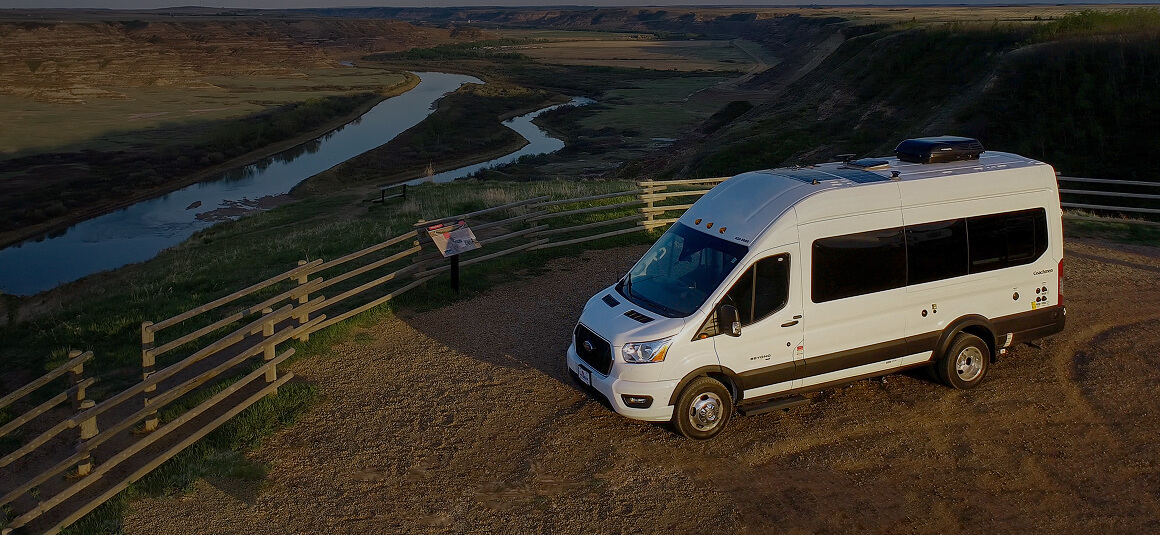
Edmonton’s main airport is coded YEG. The RV rental depots are not at the terminal, so collection day begins with a drive to the depot, not a highway drive.
Geography tells you where to go; the contract tells you what it will cost. The nightly rate answers none of the three questions: which vehicle will fit the pitch, what is included in the price, and what is refunded from the deposit. Great RV Trip answers them before you pay:

-
 Matching the vehicle to the trip. The team matches a motorhome to your dates, budget and group size.
- Contract review. The company’s specialists find extra fees and quote the full cost.
- An overnight stop to fit the dimensions. The vehicle’s length and width are checked against the pitch dimensions, and the campground is booked to those dimensions.
- International experience. The company works in more than 50 countries and holds a 4.7 rating on Trustpilot.
- Contact on the road. Great RV Trip can be reached throughout the trip and passes on the contact details for the rental company’s breakdown service.
- A note on local terms: on Canadian platforms motorhome hire is listed as RV rental, and the vehicles are classified by class. A Class B campervan is a converted panel van; a Class C motorhome is coachbuilt with an over-cab bed rather than semi-integrated; a Truck Camper (TC) is a camper unit in a pick-up bed; and a travel trailer is a trailer pulled by a tow car through a coupling. A campervan may also appear as a camper van. The pitch is called an RV park: a serviced site with electricity, water and dumping for a nightly fee. Hook-ups are the electricity, water and sewer connections, and a dump station is the point for emptying grey and black water.
Why Edmonton Works as a Starting Point and Where to Collect the Vehicle
Edmonton is Alberta’s second-largest city, and it sits on the North Saskatchewan River. The river valley runs for 48 km, the city has more than 460 parks, and the valley is recognised as the largest stretch of urban parkland in North America. Gold Bar Park and Hermitage Park appear on the city’s Major Parks list, and neither has camping, so a walk through the valley ends back at a pitch outside the city. For the cultural side of the trip the Royal Alberta Museum, the Art Gallery of Alberta and Fort Edmonton Park are open, and the festivals spread across the year: K-Days and Fringe in summer, Ice on Whyte in winter.
The nearest stop in nature is Elk Island National Park, a UNESCO biosphere reserve with more than 80 km of trails and more than 250 bird species. Bison and wapiti (elk) graze here, and the park opens daily year-round, though some services run only in summer. From there the choice is between two highways: Highway 2, the Queen Elizabeth II, runs south for about 300 km and about 3 hours to Calgary, while Highway 16, the Yellowhead, runs west, 365 km and about 4 hours to Jasper. The depots differ in distance: some are in Leduc, about 5 km from YEG and 31 km from the centre, and others in Acheson, 43–45 km from YEG and 15–19 km from the centre.
The Cost of Motorhome Hire in Edmonton
What Is Added to the Nightly Rate
Some rental companies charge the same fees at every collection point, and Edmonton is no exception. Their price list adds these items to the nightly rate:
| Item | Value |
|---|---|
| Mileage | 200 km for every paid night, cumulative across the trip |
| Kilometre beyond the allowance | CAD 0.65 |
| Camping essentials | CAD 195 one-off before tax |
| Booking essentials | a percentage of the base rate, capped at CAD 99 |
| Fuel | regular unleaded; return with a full tank, otherwise refuelling plus CAD 50 |
| Smoking inside the vehicle | CAD 1,000 plus replacement of parts |
| Late return | CAD 200 per hour |
| Fines and tolls | borne by you; if the rental company pays them, the amount plus CAD 50 |
The set of fees differs between rental companies, so you read the line items in your own contract rather than assuming they match. Some price lists also add a preparation fee of CAD 100 per booking.
The mileage allowance is cumulative: the contract sets the limit, not the individual day, so you spread the kilometres across the route as you like. The kitchen and the bedding are part of the mandatory camping essentials fee, not of the nightly rate, so you compare the nightly price with both fees included. In restaurants service is not included in the bill, and tips come to 15–20% of the total.
Commercial Rental Rates
The market sample for Edmonton runs at about CAD 60–168 per night, while starting rates in the price lists sit in the CAD 108–114 range. Within one format the spread is wider:
| Format | Rate per night |
|---|---|
| Campervan (Class B) | from CAD 104 in listings, CAD 180–315 in rental catalogues |
| Coachbuilt (Class C) | from CAD 119 in listings, CAD 196–343 in rental catalogues |
The gap between 'from CAD 104' and 'CAD 180–315' is not a contradiction: a listing shows the smallest vehicle in the lowest season, while a catalogue gives the range across the whole fleet.
Rates from Private Owners
| Format | Rate per night |
|---|---|
| Campervan | CAD 200–300, average about CAD 270 |
| Motorhome | CAD 200–350 |
| Coachbuilt (Class C) | from CAD 178 |
| Class A | CAD 167–206 |
| Trailer | CAD 100–200 |
| Trailer, including folding models | CAD 50–107 |
The segments are not averaged: listings and catalogues describe commercial hire, while private owners set individual rates. The Class A sample was collected from three listings, and one of them is in Red Deer, so its lower bound does not describe Edmonton itself. You budget by vehicle class and season rather than from an average figure: the peak falls in July and August, while May–June and September–October are cheaper.
Fuel is budgeted at 14–20 litres per 100 km and CAD 1.40–1.60 per litre in Alberta. The run to Jasper and back is 730 km, so petrol comes to about CAD 143–234.
Types of Motorhome and How to Choose
| Format | Berths | Feature |
|---|---|---|
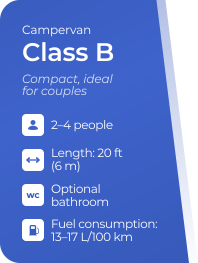
| Class B (campervan) | 2 or 4 | Two models: one queen bed or two in a bunk arrangement; rear-wheel or all-wheel drive |
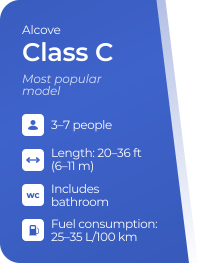
| Class C (coachbuilt) | by model | Over-cab bed, kitchen, toilet and shower |
| Truck Camper (TC) | by model | A camper unit in a pick-up bed |
| Travel trailer | by model | A tow car and a coupling are needed |
The two campervan models:
- Two-berth: one queen bed.
- Four-berth: two queen beds in a bunk arrangement.
- Both are available with rear-wheel or all-wheel drive.
- Built on a Ford Transit with an automatic gearbox and a reversing camera.
- There is no toilet or shower in the standard campervans.
Running without a hook-up:
- Espar heating runs off the fuel tank and the battery.
- The electrical system consists of two AGM batteries of 100 Ah each and a 100 or 280 W solar panel, with charging from the chassis.
- That gives about four days without a hook-up.
Rules:
- Berths and seatbelts are not the same, so check them separately.
- A trailer needs a tow car with a suitable towing capacity and a coupling; towing behind the campervan is prohibited.
- Off-road driving is prohibited, the gas stove is not used inside, and you do not climb on the roof.
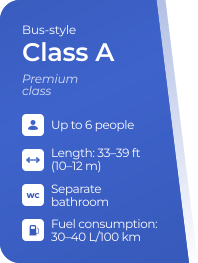
The logic is simple. For the city and the river valley you take a compact vehicle, for long highway runs a Class C, for gravel roads you look at ground clearance, and mountain roads limit the dimensions to suit the pitch.

Evgeny Byakin
Founder of Great RV Trip, who has personally driven 20,000 km along the Pan-American Highway through 13 countries
In Edmonton you choose more often between two campervan models than between classes. Look at the group: two adults are fine with one bed, a family with children needs both bunks, and extra berths cost the same as the ones you use. The second question is the bathroom. Without a shower your route is tied to campgrounds with a toilet block, not to any waterside spot, and that changes your overnight geography more than vehicle length does. The third is the tow car: without one the trailer format falls away, and the choice narrows to a compact or coachbuilt.
Choose your RV type
Licence, Age and Insurance
Campervans are hired to drivers with an ordinary car licence: no separate category is needed for a motorhome. Learner’s permits, early graduated licences and novice 'N' licences are not accepted. Foreign licences in English or French are accepted; a licence issued outside Canada, the USA and Europe may require an International Driving Permit (IDP) together with your national licence.
Campervans are hired to drivers aged 25 and over, and the rental company requires a good driving record.
Insurance comes from one of three sources: a personal policy covering cargo van hire, travel insurance, or the rental company’s protection package. Returning the deposit is a separate process, described in the booking section.
Booking, Deposits and Cancellation
You pay in full at the time of booking, and international cards may carry a 3% fee. The minimum hire is 5 nights, and bookings must be made at least 14 days before the trip. Collection starts after 12:00, early collection is available as a paid option, and you can return the vehicle until 23:59 on the last day of hire at no extra charge. The refundable security deposit is CAD 1,000 or CAD 5,000 depending on the level of cover: it is charged up to 7 days before collection and refunded within 7 days of return, provided the vehicle is intact and the tank is full. The deposit requirements and the rules for its return are explained before payment, so the amount at the desk matches what was agreed.
Cancellation Works in Two Ways
Some rental companies base the refund on the season of the trip:
| Trip between 1 May and 31 October | Refund |
|---|---|
| more than 60 days before collection | full, minus a CAD 150 admin fee |
| 30–59 days | 50% |
| 14–29 days | 20% |
| 13 days or fewer | 0 |
| Trip between 1 November and 30 April | Refund |
|---|---|
| more than 14 days before collection | full, minus a CAD 150 admin fee |
| 4–13 days | 50% |
| 72 hours or fewer | 0 |
Other rental companies use fixed amounts depending on the time left before collection instead of seasonal tables: CAD 100 is retained after confirmation, CAD 500 at 15–30 days, 50% of the nightly rate at 1–14 days, and 100% of the hire cost on the day of collection or on a no-show. Which scheme applies to your booking is set out in the contract before payment.
A one-off change of dates or a model swap is allowed by some rental companies more than 30 days before collection, subject to availability; you pay any upward price difference, and a downward difference is not refunded.
The Private Segment and Delivery
In the private segment the process is different: on a booking made more than 37 days ahead you pay 25% up front, the balance is due 37 days before the trip, and the security deposit is held 3 days before the hire starts and released within 7 days of return if the vehicle is intact. Some owners bring the motorhome right to a campground or into a provincial park and give a personal walkthrough at handover: one appointment covers both the kit and the vehicle. Some rental companies deliver within 150 km of the Edmonton station; you ask the rental company for the delivery cost before booking.
Breakdown Assistance
Roadside assistance runs 24 hours a day and covers a wheel change, fuel delivery, a lockout and towing. When equipment inside the vehicle fails, the rental company first tries to fix it over the phone, and if the fault can be put right on site and a network point is within 200 km, a technician comes out. For a serious breakdown you get a replacement motorhome if one is available. Incidental expenses during the downtime are borne by you. For damage over CAD 2,000 a police report is needed from the jurisdiction where the incident happened. The procedure and the breakdown service contact details are passed on with the booking, so you are not hunting for a number when something fails.
Booking Campgrounds
Alberta Parks opens booking 90 days ahead: the window rolls forward daily at 09:00 Alberta time (ABT). One booking covers up to 10 nights, several bookings up to 16; comfort camping and group sites are booked 180 days ahead, and group sites take a maximum of 5 consecutive nights. Arrival and departure dates within the window cannot be changed for 31 days after booking; you can cancel a booking or change its contents, with a maximum of 4 sites in one transaction. Parks Canada runs its own system. Rainbow Valley accepts only a bank-issued credit card: prepaid and debit Visa/Mastercard are not accepted. The gate card deposit is CAD 20 in cash, and it is not refunded if the card is not returned within 24 hours of departure. Site cancellation: a CAD 15 fee with more than 48 hours' notice; with less than 48 hours' notice one night is charged and the rest of the booking is cancelled.
Seasons and Climate
| Period | Months | Daytime maximum / minimum |
|---|---|---|
| High | June–August | 20.7–23.0 °C / 7.5–9.4 °C |
| Shoulder | May, September–October | 10.0–17.8 °C / −3.3 to 2.8 °C |
| Low | November–April | −6.5 to 10.1 °C / −18.1 to −3.2 °C |
Winter Changes What You Need at a Pitch
Routes and One-Way Hire
Duration: 4–7 days
Duration: 5–7 days
Duration: 2–3 days
One-Way Hire
One-way rental between Canadian cities is allowed, and some rental companies have a depot in Whitehorse, so the Edmonton → Whitehorse direction is available. For long one-way runs some rental companies require a minimum of 7 nights.
| Direction | Fee |
|---|---|
| Edmonton → Vancouver | CAD 1,200–1,550 |
| Calgary → Vancouver | CAD 1,550 |
| Edmonton → Calgary | no fee with some rental companies |
| Edmonton ↔ Whitehorse | CAD 1,500 |
| Other directions | CAD 1,100 in some price lists |
| Heading north | CAD 690 per booking |
The spread on a single direction reflects different price lists, not different terms of one booking, so you check the fee before payment. Relocation deals are published at 50% off the standard fee, with a limited date window; they are not announced a season ahead, so you watch for them in advance.
The northern surcharge is added to trips north of Fort St. John and Kitwanga in British Columbia, north of Peace River in Alberta, north and east of Sept-Îles in Quebec and Labrador, and to the Northwest Territories, Yukon, Nunavut and Newfoundland.
A trip into the USA is allowed with no surcharge for crossing the border, but the vehicle is returned in Canada: you cross the border with your entry documents and bring the vehicle back into Canada.

Discover the Canadian Rockies, spectacular glaciers, turquoise mountain lakes and scenic drives through Jasper and Banff National Parks.

Discover free-roaming bison, peaceful forest trails, open prairie landscapes and small Alberta towns.

Explore the dramatic Alberta Badlands, discover dinosaur fossils and enjoy mountain scenery in Waterton Lakes National Park.
Evgeny Byakin
Travelling by motorhome since 2018
The main mistake on routes out of Edmonton is assuming the vehicle and the pitch are booked in the same window. Campgrounds open before the rental company accepts a booking for the camper, so you take the site first and the vehicle to suit it. Then comes the pace: one park a day, with time allowed for setting up in the evening. The mountain leg and the northern leg do not go into one trip: they run from the city in opposite directions, and the return leg eats up a day.
Campgrounds, Overnight Parking and Passes
Rainbow Valley Campground
Edmonton has one campground inside the city limits: Rainbow Valley runs from the May long weekend to mid-October, the peak falls in July and August, and the regular season covers May, June, September and October. There are no weekly rates in the peak. There are no water hook-ups on site: a drinking-water station and a dump station are on the grounds, and electricity is limited to 15 amps. Dumping for unregistered guests costs CAD 40. The Rainbow dome costs CAD 250 or CAD 300, and Snow and Gem cost CAD 300 or CAD 350, with a minimum of 2 nights in the peak and on Friday–Saturday. Rates exclude 5% GST and a 3% booking fee.
| Rainbow Valley pitch | Per night, before GST and fee |
|---|---|
| With electricity, regular season | CAD 49.00 |
| With electricity, peak | CAD 53.00 |
| Without electricity, regular season | CAD 44.00 |
| Without electricity, peak | CAD 48.00 |
| A week with electricity, regular season | CAD 294 |
| A week without electricity, regular season | CAD 264 |
Alberta’s Provincial Parks
Miquelon Lake charges CAD 25 per night and has 269 sites, with bookable dates from 13 May to 12 October within a year-round season. Wabamun Lake runs from 24 April to 30 October with 276 sites, and Pigeon Lake is open year-round with booking from 13 May to 20 September and 247 sites. Booking goes through shop.albertaparks.ca, and the seasonal boundaries are given in the table. The Great RV Trip team helps you put together a list of sites for your trip dates and checks the vehicle’s dimensions against the pitch dimensions.
| Park | Rate per night | Sites | Season |
|---|---|---|---|
| Miquelon Lake | CAD 25 | 269 | year-round, bookable 13 May – 12 October |
| Wabamun Lake | on the park’s own scale | 276 | 24 April – 30 October |
| Pigeon Lake | on the park’s own scale | 247 | year-round, bookable 13 May – 20 September |
Elk Island National Park
Overnight stays are charged at national park rates, and entry is paid separately from camping. Children up to and including 17 enter free; free entry also applies to new permanent residents and citizens of Canada, to a person accompanying a visitor with a disability, and to serving members and veterans of the Canadian Armed Forces with their immediate family. The Canada Strong Pass ended on 7 September 2026; standard rates apply from 8 September, and passes valid during its 2025 or 2026 periods were extended automatically.
| Product | Price |
|---|---|
| Daily entry | CAD 10.00 adult · CAD 8.75 senior · CAD 19.50 family or group of up to 7 in one vehicle |
| Commercial group | CAD 8.50 per person |
| Annual pass for this park alone | CAD 48.25 adult · CAD 42.50 senior · CAD 96.75 family |
| Annual Early Bird, 1 December – 31 March | CAD 38.75 adult · CAD 34.00 senior · CAD 96.75 family |
| Parks Canada Discovery Pass | CAD 83.50 adult · CAD 71.50 senior · CAD 167.50 family or group of up to 7 |
| Astotin Lake, night without services, toilet block with showers | CAD 31.75 per pitch |
| Overflow | CAD 19.50 per pitch |
| oTENTik | CAD 147.50 per unit |
| Backcountry Oster Lake | CAD 15.00 per person per night |
| Snowshoe hire | CAD 23.00 per pair per day |
| Booking fee | CAD 11.50 online · CAD 13.50 by phone |
| Pass replacement | CAD 18.50 |
The Discovery Pass runs for 12 months at more than 80 Parks Canada places. The Elk Island annual pass pays for itself on the 5th visit: 48.25 / 10.00 = 4.825, rounded up to 5. The family pass works the same way: 96.75 / 19.50 = 4.96, rounded up to 5.
Two Different Alberta Passes
| Pass | Price | Scope |
|---|---|---|
| Kananaskis Conservation Pass | CAD 15 per day · CAD 90 per year | per vehicle, up to 3 vehicles on the annual pass; Kananaskis Country and the Bow Valley corridor |
| Public Lands Camping Pass | CAD 20 for 3 days · CAD 30 per year, plus a CAD 3.25 fee and GST per transaction | per person; Eastern Slopes, year-round for wild camping |
The Kananaskis Conservation Pass carries no surcharge for a trailer or passengers, but it does not transfer to another vehicle. It is not needed in Ghost, McLean Creek PLUZ and PRA, Fisher Creek PRA, the town of Canmore or on municipal land inside the boundary; inside this pass’s zone the Public Lands Camping Pass is not required. Camping fees and specialised facilities still apply with a KCP. The Public Lands Camping Pass is not needed in a campground with a nightly fee, but it is needed on node sites without a fee.




Overnight in the City and on Public Lands
The city allows a motorhome to park on the roadway directly outside the owner’s private residence for up to 72 consecutive hours, after which the vehicle is moved off the street for at least 48 hours; after 72 hours any vehicle is treated as abandoned, and the fine is CAD 50 plus towing at the owner’s expense. A visiting hirer has no residence in Edmonton, so this permission does not apply to you: an overnight stay in the city outside a campground is not part of the plan. Zoning bylaw 5.120 prohibits a large motorhome in the front and side yard except for loading and unloading; the exception from 1 April to 31 October applies where there is no laneway, with parking on the driveway and a setback of at least 0.6 m from the pavement or kerb, and fines start at CAD 250.
Public land in Alberta allows a stay of up to 14 days, after which the camp is moved at least 1 km for 72 hours. Wild camping is prohibited within 1 km of a Public Land Recreation Area, a provincial park or a Provincial Recreation Area (PRA). Within 1 km of the road, camping is prohibited in Kananaskis PLUZ, McLean Creek OHV PLUZ, Sibbald and Cataract Creek Snow Vehicle PLUZ. In a provincial park, PRA and PLRA, camping is allowed only on designated sites.
Dump stations operate at Rainbow Valley and on Alberta Parks sites; south of the city there are stations in Leduc (the Public RV Dump Station at the Eco Station, plus Glowing Embers RV Park and Leduc Lions Campground), and some stations charge unregistered guests.
Driving, Parking and Apps
The city limit is 50 km/h by default unless a sign says otherwise; on Highway 16 in Jasper National Park the limit is 90 km/h. The 'slow down, move over' rule requires you, in the lane nearest a stopped vehicle with its beacons on, to move into the far lane; where that is unsafe, you slow to 60 km/h or to the posted limit, whichever is lower. The rule covers police, ambulances, fire services, tow trucks and road machinery, including vehicles in work zones. A breach carries a CAD 243 fine and 3 demerit points, plus the speeding fine, and speeding fines double where road crews are working or a vehicle with beacons is stopped. The changes came into force in September 2023. Following within 150 m of an emergency vehicle with its siren or beacons on is prohibited.
You pay for parking in Edmonton through the city’s EPark system: the HotSpot app, online or by phone. Useful apps: shop.albertaparks.ca for provincial campgrounds, the Parks Canada Reservation Service for national ones, 511 Alberta for roads, iOverlander for overnight spots and GasBuddy for fuel. Public transport is run by Edmonton Transit Service (ETS), and the city’s official tools list a third-party app, Transit, with a free Royale tier for the Edmonton region.
You fill the fresh-water tank and refill the propane (liquefied gas) for the stove and heating before setting off for remote areas. There are bears in the Rockies, so food and rubbish are kept in the vehicle or in sealed containers.
FAQ: RV Rental in Edmonton
Conclusion
Your overnight stop is not tied to a hotel address: you can sleep where the day’s drive ended. But the bill is not made up of the nightly rate alone: the kitchen and the bedding are part of a mandatory fee, and the deposit comes back only with the vehicle intact, the tank full and the contract terms met. Great RV Trip explains the deposit requirements and the rules for its return before payment, so the terms are known before you sign, not at the desk when you bring the vehicle back.

E-mail: info@greatrvtrip.com


Contact us
Address:
2093 PHILADELPHIA PIKE #7170
CLAYMONT, DELAWARE 19703, USA
© GREAT RV TRIP, 2017–2026
Motorhome travel agency
Let's go on an adventure!
We use cookies and similar technologies to improve your browsing experience, analyze site traffic and serve targeted advertisements.
For more details, read our Privacy & Data Protection Policy and Cookies Policy.