
RV Parks and Campgrounds in the USA: How Much They Cost and Where to Stay

    Leave a number with WhatsApp / Telegram
    An overnight stop in the USA can cost nothing at a permitted dispersed campsite or more than $ 150 at an RV resort. Between those extremes, you can book a simple site inside a national park, a state-park campground near a lake, or a private RV park with electricity, water and sewer connections.

    Your choice affects both the budget and the next day’s plans. A campsite near the trails can save a morning drive. A site with electricity can make a hot night more comfortable. Before booking, check three things together: the total price, the connections at your individual site, and whether your motorhome fits.

    The prices below are in US dollars for a campsite, not for renting the motorhome. Broad ranges are planning guides; named campground examples show published rates where these could be verified. Taxes, park admission and optional services may be additional. Research checked in September 2026.

    How much does RV camping cost per night?

    Harvest Hosts' 2025 planning guide suggests $ 30-$ 55 for basic electric/water campgrounds, $ 55-$ 90 for full-hookup sites, and $ 90-$ 150 or more for premium stays. Use these dated benchmarks for a first budget, then obtain quotes for your dates. Free nights are possible where overnight camping is permitted, but you still need water, power and a way to empty the waste tanks.
    Type of overnight stop
    Planning range per night
    Hookups
    Best use and booking considerations
    National-park campground
    Often $20–$60; serviced sites can cost more
    Frequently none; exceptions exist
    Staying inside the park. Check the specific booking window and vehicle limits.
    State-park campground
    Roughly $20–$60+
    None, electric only, partial or full
    A nature-focused stop. Use the state’s booking service and check nonresident and entry charges.
    Private RV park
    Roughly $40–$100+
    Choose the connection type when booking
    Convenient service stops and family stays. Compare the final price for your party.
    RV resort
    Roughly $90–$150+
    Full hookups are common
    Pools, larger sites or waterfront locations. Check vehicle eligibility and minimum stays.
    Permitted dispersed camping
    Often $0
    None
    Self-contained travel. Verify land access, road conditions and local restrictions.
    Store or other business parking
    May be $0 with permission
    Usually none
    A short overnight rest. Confirm permission at that exact property.
    "RV park" usually describes a property with pitches for recreational vehicles. "Campground" can include RV sites, tent pitches and other accommodation. "RV resort" suggests more facilities, but the name alone tells you little about the quality or what your rate includes.

    Check that you are booking an occupied overnight RV site. A cheap "RV parking" or "storage" rate may only cover leaving an empty vehicle. Cabins and stationary rental RVs are separate accommodation products; they are not included when you rent an RV pitch.

    How prices vary across US regions

    Location matters, but comparing similar sites matters more. A dry national-park campsite and a private waterfront resort can sit in the same region and have very different prices.

    The regional ranges below come from Harvest Hosts' published 2025 planning guide. They are useful starting points, not measured 2026 averages or current quotes. For your trip, replace them with prices for the dates and site types you actually want.
    Region
    Published planning range
    What to compare locally
    West Coast: California, Oregon, Washington
    $60–$120
    Coastal sites versus inland alternatives
    Northeast: New York and New England
    $45–$95
    Summer dates, autumn foliage weekends and seasonal closures
    Southeast, including Florida
    $50–$100
    Florida winter stays, waterfront sites and inland options
    Mountain states: Colorado, Idaho, Wyoming, Montana
    $30–$60
    Public campsites versus private parks near major attractions
    Midwest, including Michigan, Illinois and Ohio
    $25–$55
    Basic sites versus serviced or lakefront pitches
    Southwest: Arizona, New Mexico, Nevada, Utah
    $35–$70
    Desert destinations, local events and full-hookup sites
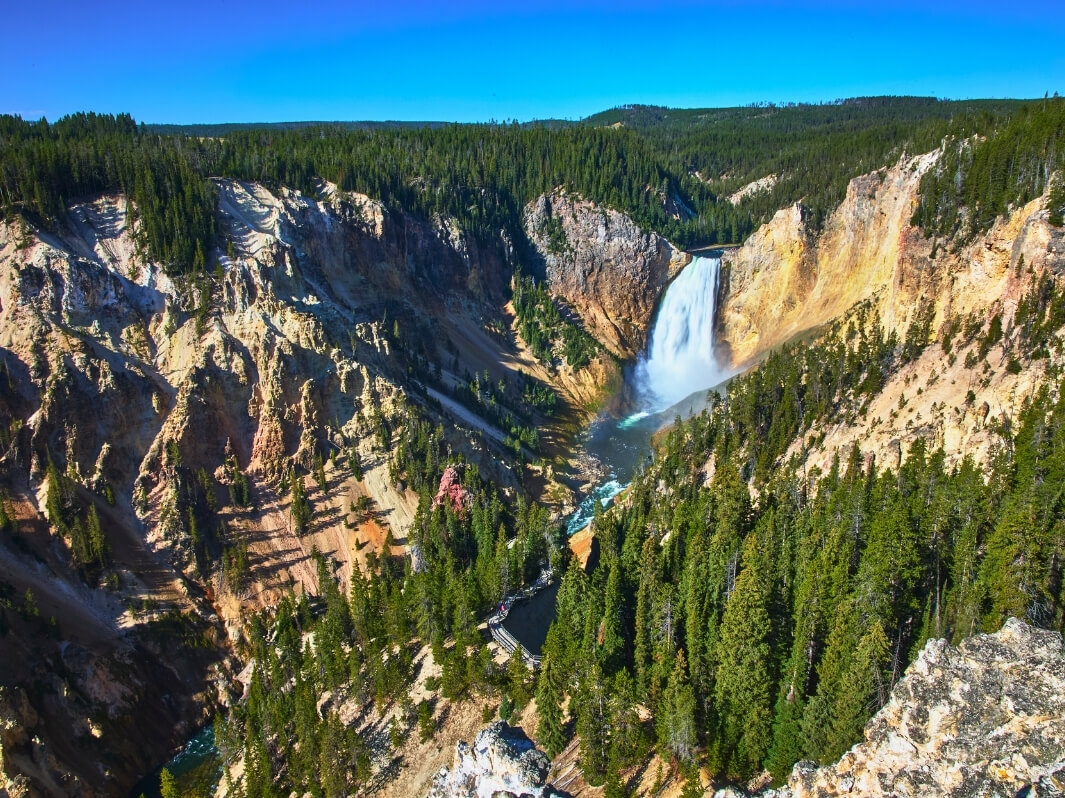
    A regional range can understate a particular stop. Yellowstone, for example, lists Madison Campground at $ 38 plus taxes and Fishing Bridge RV Park at $ 94 plus taxes for 2026. The second has full hookups. Look at the actual campsite before deciding that a mountain-state stop will be inexpensive.

    RV hookups: what the booking terms mean

    Hookups are the utility connections at your pitch. A campground can have drinking water and a dump station somewhere on the property while your own site has no hookups at all.
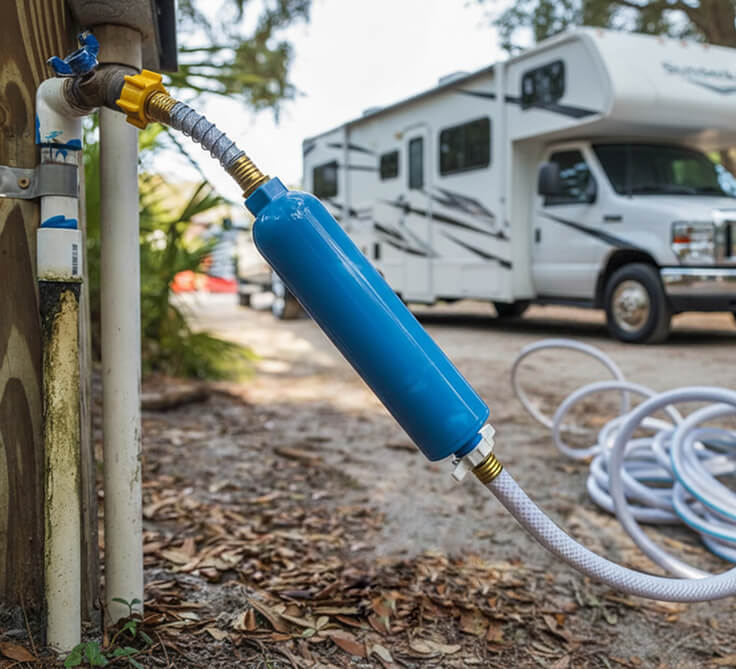
    RV water hookup

    Water

    A tap connects to the motorhome’s city-water inlet using a drinking-water hose. Confirm that the supply is potable and follow the rental company’s instructions on pressure regulation. Some systems supply the taps directly without filling the onboard tank.
    RV electric hookup

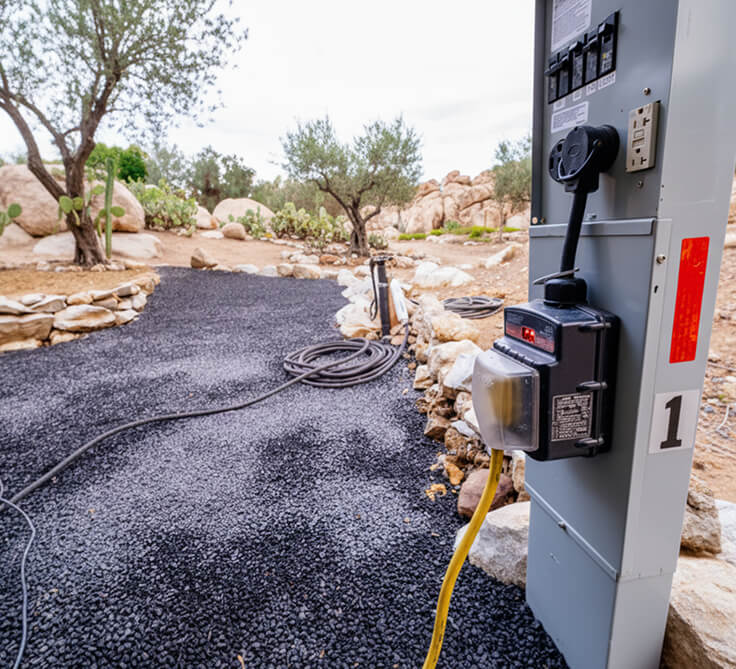
    Electric

    The pitch has a power connection, commonly labelled 30 amp or 50 amp. Match it to your rental vehicle’s requirements. A larger motorhome may need 50-amp service to run more appliances together; vehicle size alone is not a reliable guide.

    RV sewer hookup

    Sewer

    A connection at the pitch lets you empty the motorhome’s waste tanks through the proper sewer hose. Follow the handover instructions for tank valves and emptying.

    Full hookups, or FHU
    Electricity, water and sewer are available at the site.
    Partial hookups
    Only some connections are available, often water and electricity. Read the listing rather than assuming both are included.
    Dry camping
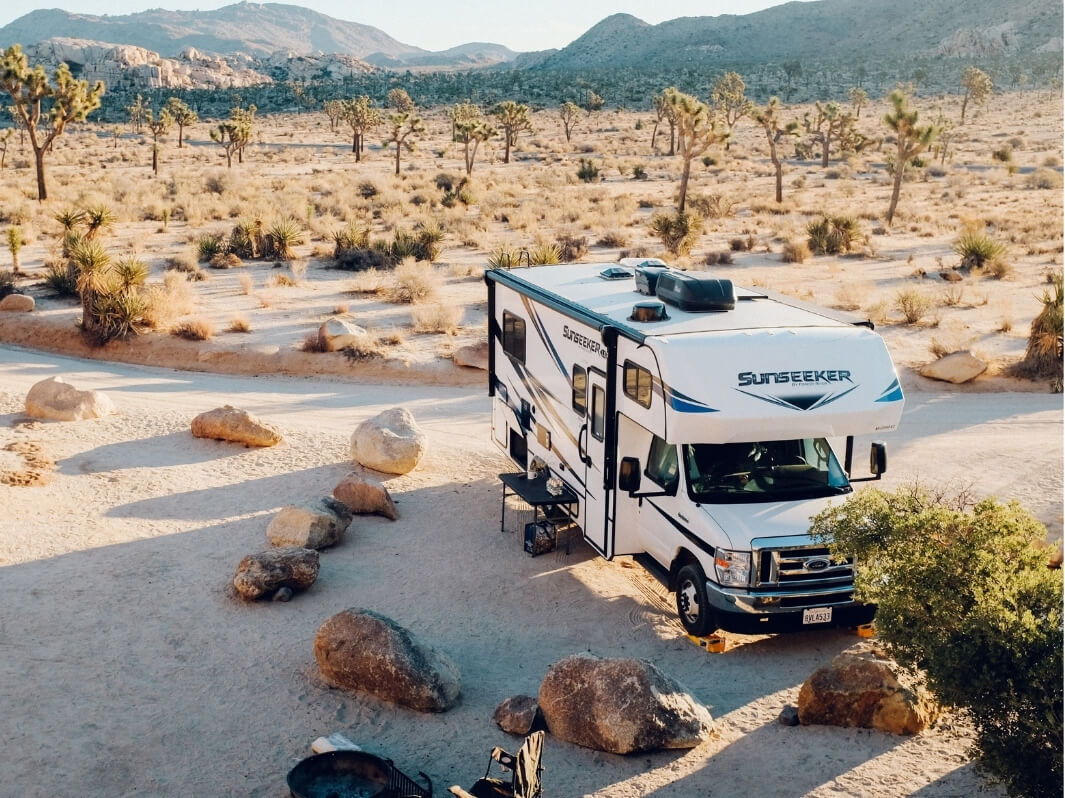
    The site has no hookups. You use the vehicle’s onboard resources. Boondocking usually describes this kind of self-contained stay, often outside a developed campground; it does not automatically mean the location is free or legal to use.
    At pickup, ask the rental team to show you the connections, supplied hoses, electrical cable and any approved adapters. Confirm which appliances work from the battery, which require external power or a generator, and how generator use is charged.

    If you need air conditioning overnight, choose an appropriate electric site unless the rental team confirms your vehicle has another suitable power setup. Generator restrictions can make a dry site impractical in hot weather. Plan dry-camping nights around your water, battery and waste-tank capacity, the weather and the generator rules.

    Camping inside national parks

    Staying inside a national park can put you closer to trails, viewpoints and park transport. The trade-off is that many sites have limited services, strict vehicle-size limits and competitive reservations. You may have toilets and a drinking-water point without showers or hookups at your pitch.

    Start on the park’s official National Park Service page and follow its reservation link. Many campgrounds use Recreation.gov; some are run by concessioners with separate booking systems. Yellowstone, for example, splits campground reservations between Recreation.gov and Yellowstone National Park Lodges.
    How to book a campground step by step
    US campgrounds use several booking channels, depending on who manages the property.
    • Mark the areas where you want to stop before searching for individual campgrounds. On Google Maps, try "RV park," "RV camping" and "campground," then open the operator’s own website to confirm the details.
    • For a federal campground, start with the relevant National Park Service or land-management page. Follow its official link to Recreation.gov or to the concessioner that handles reservations.
    • For a state park, use that state’s park website. Some states operate their own booking system; others direct travellers to ReserveAmerica. The booking window and fees are set by the state or individual park.
    • For a private RV park, use its own booking engine when available. If the website shows no online availability or tells guests to call, contact the office during its stated hours. Confirm the dates, total price, site type, hookups, RV length limit, cancellation terms and late-arrival procedure. Ask for written confirmation.
    • Some public campgrounds have first-come, first-served sites. These cannot be held in advance: check the current operating status and arrive early. Keep a reservable alternative for busy parks and weekends.
    • Use late self-check-in only when the campground provides that procedure. Follow its instructions for choosing a site and paying; an apparently empty pitch may already be reserved.
    Telephone booking is still part of some official systems. Texas State Parks, for example, says that group facilities, most accessible sites and some park sites must be reserved by phone. Georgia State Parks accepts online bookings through ReserveAmerica or by phone and publishes its own self-check-in process. These are examples of state-specific rules, so follow the instructions for the exact campground.
    Booking windows and generator hours
    Check the release date for the individual campground. Watchman in Zion offers reservations up to six months ahead. Yosemite uses several booking windows; its general guidance releases many Pines sites five months ahead on the 15th of the month at 7 a.m. Pacific Time. North Pines also has a separate early-access lottery arrangement for 2026. Convert the stated time zone for the date of release, including daylight-saving changes.

    Create your account before reservations open, enter the vehicle details accurately, and have a second campground in mind. Popular releases can sell out within minutes. A campsite showing "unavailable" may be sold out, not yet released, closed for the season or unsuitable for the vehicle you entered.

    Generator hours also vary. Yosemite allows them from 7−9 a.m., noon-2 p.m. and 5−7 p.m. Its campgrounds have no hookups. Watchman has electric RV sites but no full hookups. Check the rules for your campground and loop before relying on a generator.
    Ten national parks to compare
    These examples help you compare motorhome stops. Prices apply to the named site type and were checked against published sources in September 2026. Earlier official schedules list $ 45 for Watchman electric sites and $ 30 for Blackwoods standard sites; verify their current 2026 prices when booking.
    Great Smoky Mountains National Park

    Great Smoky Mountains

    Nightly fee
    $30
    Site services
    No ordinary RV hookups
    Practical point
    Check parking-tag requirements for stops elsewhere in the park.
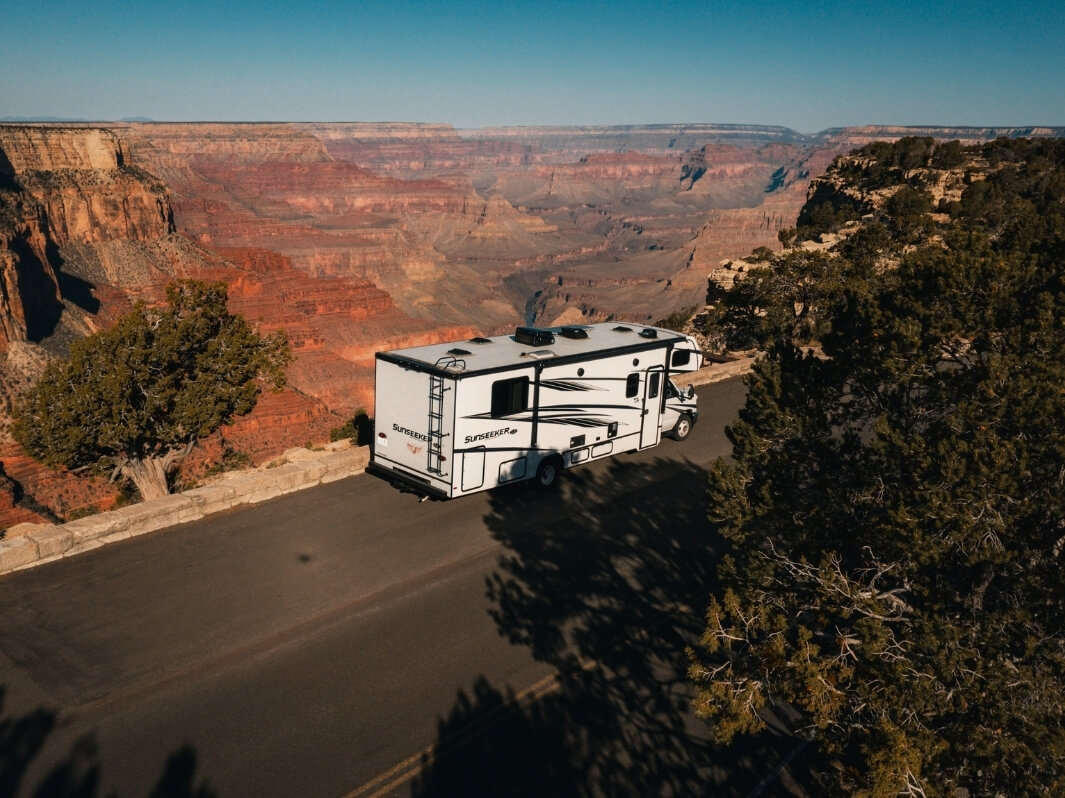
    Grand Canyon National Park

    Grand Canyon

    Nightly fee
    $30
    Site services
    No hookups
    Practical point
    Vehicle limit: 30 ft; check the individual site’s fit.
    Yellowstone National Park

    Yellowstone

    Nightly fee
    $38 / $94, plus taxes, in 2026
    Site services
    Madison: no hookups; Fishing Bridge: full hookups
    Practical point
    Different service levels create a large price difference.
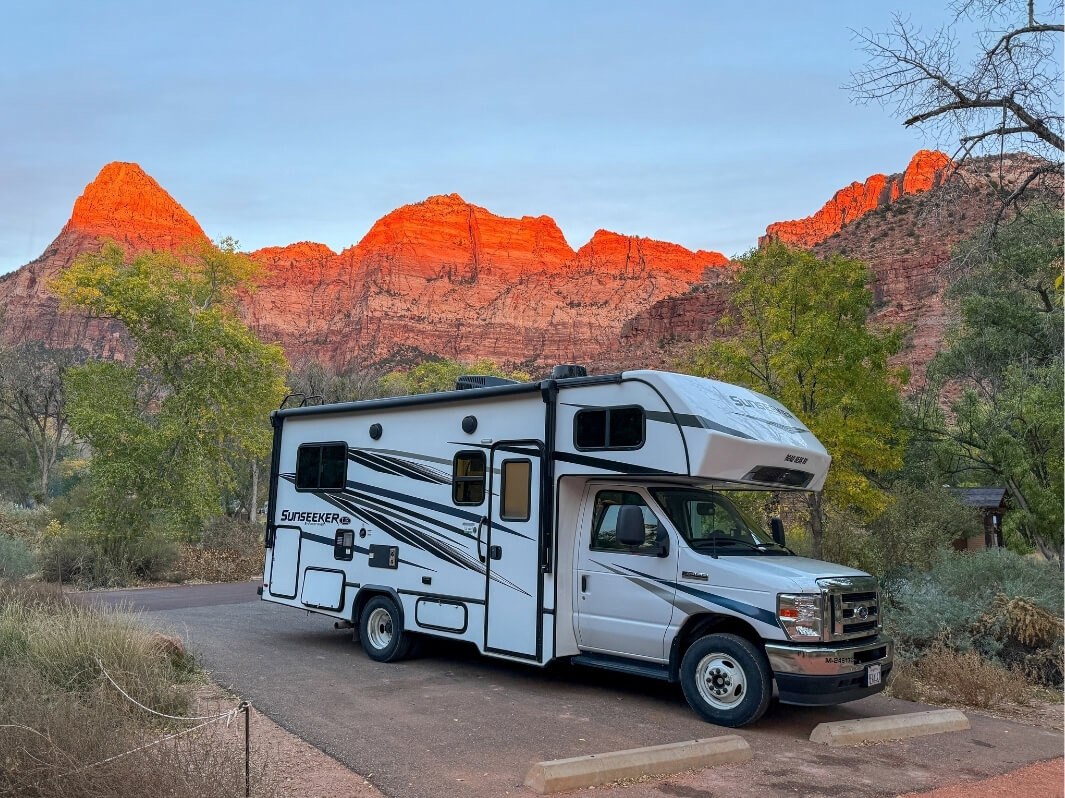
    Zion National Park

    Zion

    Nightly fee
    $45 electric site
    Site services
    Electric RV sites; shared water and dump station
    Practical point
    Book the correct RV site category; reconfirm the published fee.
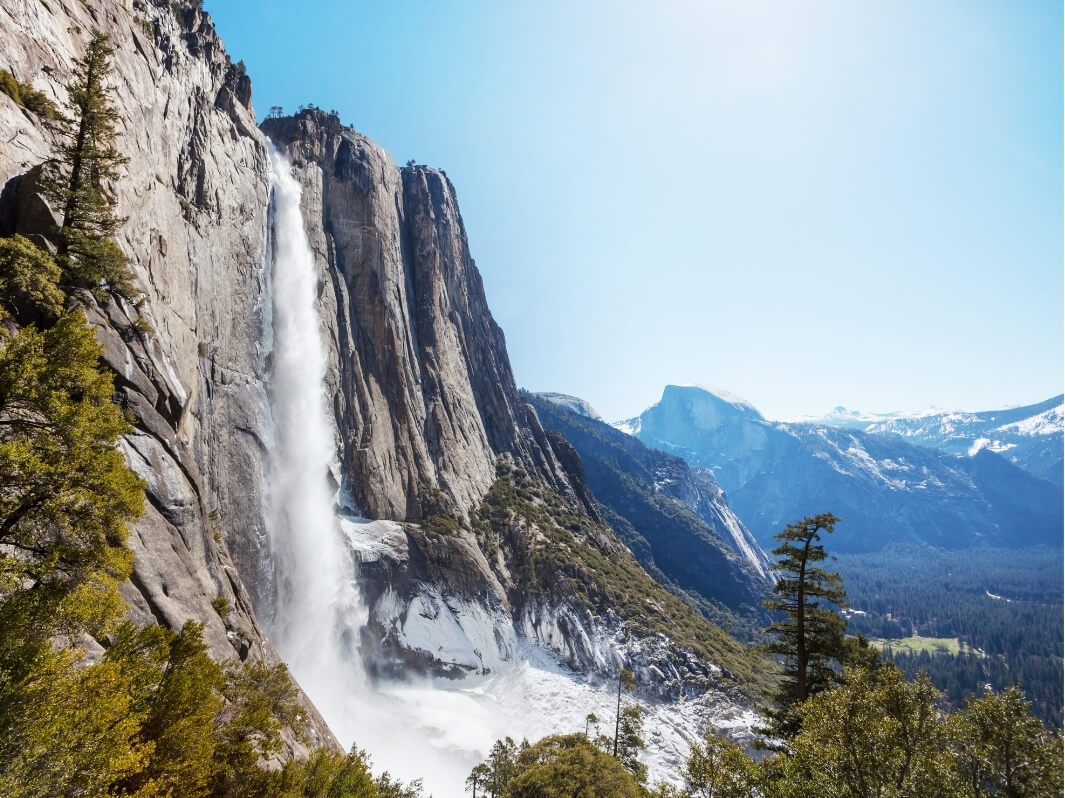
    Yosemite National Park

    Yosemite

    Nightly fee
    $36 in 2026
    Site services
    No hookups
    Practical point
    Maximum RV 35 ft; individual sites can be shorter.
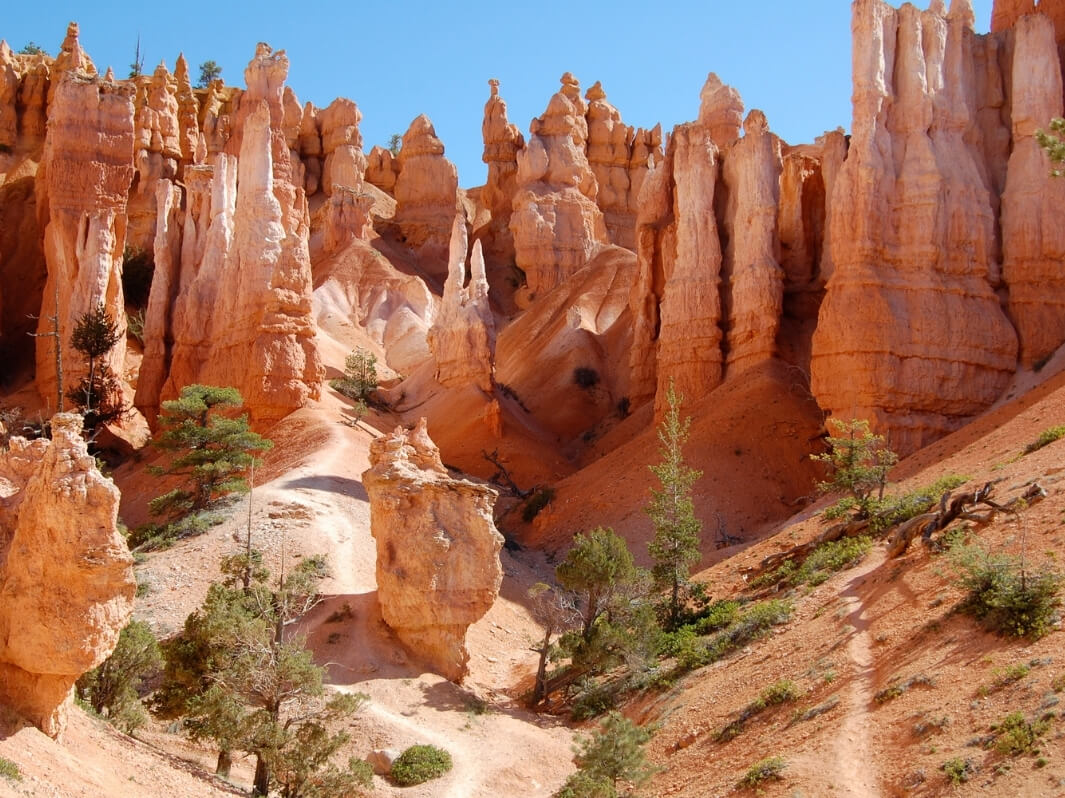
    Bryce Canyon National Park

    Bryce Canyon

    Nightly fee
    $30 per RV site
    Site services
    Check individual campground facilities
    Practical point
    The two campgrounds have different booking windows.
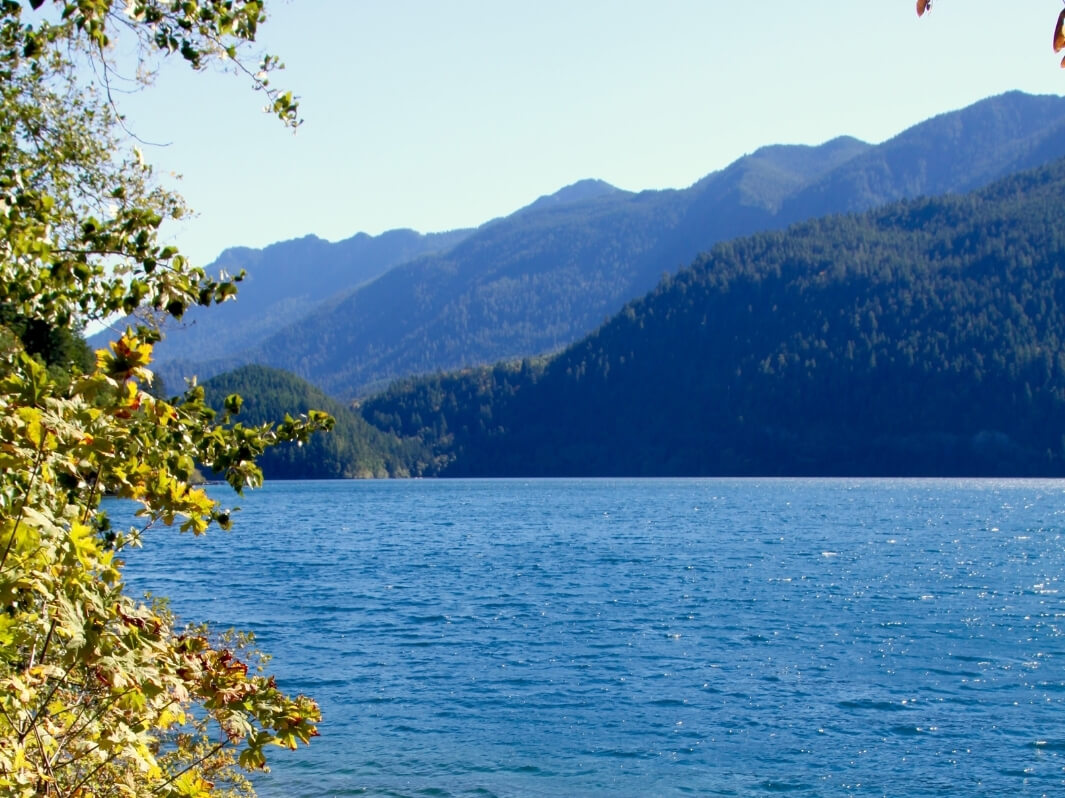
    Olympic National Park

    Olympic

    Nightly fee
    $24; dump station $10
    Site services
    Shared water and dump station
    Practical point
    Many sites fit shorter RVs; some accommodate up to 35 ft.
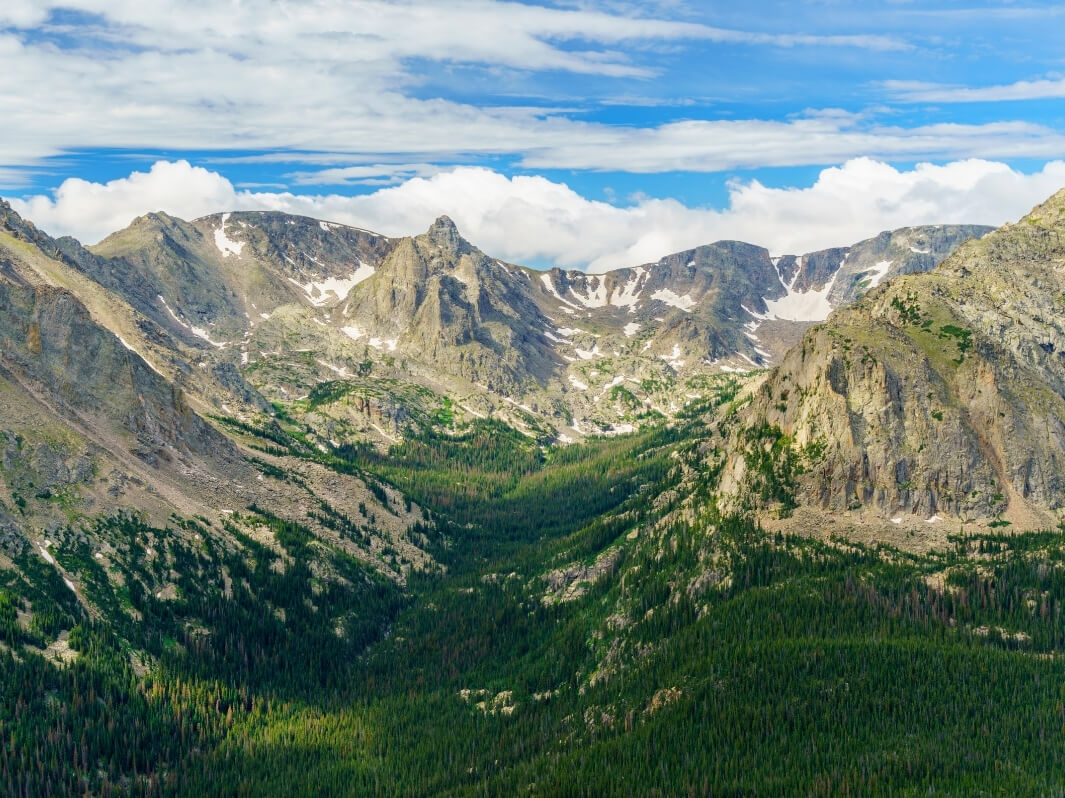
    Rocky Mountain National Park

    Rocky Mountain

    Nightly fee
    $30 non-electric / $55 electric
    Site services
    No water hookups
    Practical point
    Check current rates and availability before booking.
    Acadia National Park

    Acadia

    Nightly fee
    $30 standard site
    Site services
    No hookups
    Practical point
    Choose an RV-compatible site; reconfirm the published fee.
    Budget for park admission separately and check whether your campground booking changes any timed-entry requirements. An annual entrance pass does not generally cover campground fees. International visitors should check the park’s current nonresident entry and pass conditions as part of the trip budget.

    Private RV parks and resorts: compare the total stay

    Private campgrounds are useful when you want an electric site, a laundry stop or facilities for children. KOA, RJourney and Sun Outdoors are names you will encounter while planning. Their properties and site categories differ, so a network name does not guarantee full hookups, a pool or the same standard everywhere.

    For a family stay, check whether the pool will be open during your visit, whether children count towards occupancy charges, and whether the site is close to the facilities you need. For a lakefront pitch, confirm that the actual site has the advertised position. If you need to work online, ask about connectivity at the pitch rather than relying on a Wi-Fi icon.

    Before paying, review:
    • The number of adults, children and vehicles included in the rate.
    • Any extra-person, pet, booking, site-selection or optional-service charges.
    • Taxes, minimum-stay rules and the total due for the full reservation.
    • Deposits, cancellation terms and any non-refundable charges.
    • Check-in hours and the procedure for arriving after the office closes.
    Extra-person, pet and booking charges differ by property. Request a quote for your complete party and use that total to compare properties.
    The 10-year rule
    Some private parks restrict older RVs or require photographs and approval before accepting them. Others have vehicle-type or condition requirements. Ask before paying if the listing mentions a 10-year rule, particularly when the rental company has not confirmed the exact vehicle yet. A rental booking does not by itself establish an exemption.
    Is a campground membership worth buying?
    Good Sam lists Standard membership at $ 39 per year and a 10% discount on nightly rates at participating Good Sam campgrounds. Check the discount conditions, whether it applies to your booking, and any restrictions affecting customers outside the USA. Membership renews automatically unless cancelled.

    At a 10% discount, $ 390 of eligible campsite spending would recover a $ 39 membership fee before any taxes. Count only bookings where the discount is confirmed. Do not assume it applies to a weekly promotion, a monthly rate or every campground in a private network.

    State parks: nature with a wider range of services

    State parks can work well when you want walks, water access or a quieter base outside a major destination. Their campsites range from unserviced pitches to full hookups. Booking systems, resident pricing and reservation windows vary by state.

    Use the state park authority’s website to reach the correct booking service. Check whether the rate is for state residents and whether you must also pay a vehicle-entry fee. A national-parks pass does not automatically cover a state park.

    Cherry Creek State Park near Denver is one example with year-round full-hookup sites, showers, laundry and a dump station. Book through Colorado Parks and Wildlife’s reservation service and get a current quote for your RV site. Budget for park-entry charges separately.

    State parks can also provide alternatives near national parks, but check the actual drive to the entrance you plan to use. A campground that looks close on the map may be a long drive from that day’s trailhead. Popular state-park sites can be just as competitive as national-park reservations.

    Free overnight stops: public land and business parking

    Boondocking on public land
    BLM land and national forests offer dispersed-camping opportunities, particularly on western routes. Check the exact area with the responsible land manager: some land is closed to camping, some requires designated sites or permits, and developed campgrounds may charge a fee.

    BLM’s general guidance commonly limits dispersed stays to 14 days in a 28-day period, with local variations and relocation requirements. National forests have their own local orders, so check the local office before choosing a site.
    Before choosing a spot, check that the access road is suitable for your vehicle and permitted by the rental contract. Look for turning space, surface conditions and current restrictions. A recommendation in an app does not confirm that a long rental motorhome can reach the location.

    Arrive with enough drinking water, suitable power reserves and waste-tank capacity. Follow Leave No Trace principles: use existing disturbed areas where allowed, take rubbish away, protect vegetation and respect wildlife. Empty RV wastewater only at an authorised disposal facility. Check fire restrictions before using a fire ring or lighting a stove outdoors.
    Walmart, restaurants, casinos and travel centres
    Walmart’s published policy leaves RV parking permission to individual store managers, taking local law and available space into account. Contact the exact store and ask specifically about staying overnight. Signs or local restrictions may rule it out even when another Walmart allowed it earlier in the trip.

    The same verification approach applies to Cracker Barrel, Cabela’s and casinos: ask that property whether an overnight RV stay is permitted, where to park, how long you can remain, and whether there is a charge. Do not assume there will be designated spaces, security cameras or permission based on the brand alone.

    Pilot/Flying J advertises RV services including overnight parking, dump stations and propane. Check the individual location for available facilities and prices. For Love’s, check the location’s current RV-stop type, RV-friendly parking, hookups and dump-service availability; conditions vary by location.

    Keep a permitted business-parking stop compact and follow the property’s instructions. Ask before extending slide-outs or using equipment outside, and leave access lanes clear. Treat the stop as a rest break rather than an opportunity to set up an outdoor camp.

    There is no single nationwide rule allowing or banning sleep in every parking lot or roadside rest area. Local rules, land ownership and posted restrictions determine what is permitted. In national parks such as Yosemite and Joshua Tree, roadside parking is not an alternative to a registered campsite. Verify the exact location rather than relying on a general claim about US parking laws or fines.

    Harvest Hosts and Boondockers Welcome

    Harvest Hosts offers overnight stays at participating farms, wineries, breweries, museums and other businesses. Its Classic membership lists a regular price of $ 99 per year; promotions and other plans vary. The membership network covers North America, so check which locations and benefits are included in your chosen plan.

    Arrange each stay with the host and use a self-contained RV with the required onboard facilities. The programme asks members to support the host’s business. Budget for purchases or activities as well as membership, and read the current member guidance and individual host’s requirements.

    Most visits are one night. Some hosts offer longer stays or hookups, with terms and possible extra charges shown in the listing. Confirm these before arrival, along with generator permission and business hours.

    Boondockers Welcome focuses on stays hosted on private property and is available through separate or combined membership options. Compare actual hosts along your route before joining either programme. A membership is most useful when its locations fit the trip you already want to make.

    Weekly and monthly RV park rates

    If you plan to remain in one place, ask for a weekly or monthly quote. Compare the full cost with the nightly alternative, including electricity, taxes and any deposit. Discounts depend on the park, season and site category.

    Camp Landa in New Braunfels, Texas, currently advertises monthly RV sites from $ 1,000 to $ 1,300 for its listed autumn 2026-spring 2027 season, with utilities included. Its published terms cap the stay at six months. This is a specific park example, not a US monthly average or a guarantee of availability.

    Other parks may meter electricity separately, restrict long stays to certain pitches, or require a longer minimum booking. If you are searching for RV parks under $ 500 a month, check carefully what that price covers: location, season, utility charges and permission to occupy the RV all matter.

    Monthly prices suit travellers who want one base. If you rent a motorhome for 25 days but move every few nights, each campground will normally price its own stay separately. The vehicle’s long-rental rate and a campground’s monthly pitch rate are different parts of the budget.

    Dump stations: emptying tanks without booking a night

    After dry camping, you need an authorised place to empty the waste tanks. Search for "RV dump station" along your route and check opening hours, fees, access for your vehicle and whether drinking-water refill is available separately.

    Some campgrounds include dumping for registered guests; others charge even when you stay. Olympic’s Fairholme page, for example, lists a $ 10 dump-station fee in addition to its $ 24 campsite rate. Pilot/Flying J also advertises dump stations at participating locations, but its public RV-services page does not give one nationwide tariff.

    If emptying the tanks is the only service you need, compare a standalone station with paying for a campsite. Follow the rental handover instructions, use the proper hose and fittings, and keep drinking-water equipment separate from wastewater equipment. A water tap beside a dump point is not necessarily a potable-water source.

    Apps and websites to prepare before departure

    Use a discovery service to find candidates, then confirm the booking and rules with the operator. Save reservation details and directions before entering areas with weak mobile coverage.
    Tool
    Useful for
    What to verify elsewhere
    Reservations at many federal campgrounds and access to booking confirmations
    The park’s release schedule, closures and site restrictions
    RV parks, public-land stops, reviews and dump-station searches
    Current permission, prices and access-road suitability
    Comparing campgrounds, photos and traveller reviews
    Which facilities operate during your visit
    Traveller-reported overnight stops and practical service points
    The age of each report and permission from the landowner or manager
    State-park reservation websites
    Booking the state’s campsites
    Resident eligibility, entry fees and vehicle limits
    Finding and arranging member stays
    Plan coverage, host approval and extra-service terms
    For fuel, GasBuddy is another service to consider when comparing nearby stations. Check the price timestamp and the amount displayed at the pump; a cheaper station may involve a detour or a tight forecourt.
    A booking checklist for international visitors

    Get the motorhome’s actual length and height from the rental company, in feet as well as metres. One foot is 0.3048 metres.

    Check the specific pitch: RV or tent-only, length limit, hookup type and space for slide-outs.

    Choose a pull-through site if you want to drive through the pitch; a back-in site requires reversing into it.

    Enter every traveller and pet before comparing totals. Check any residency-based pricing conditions.

    Confirm that your card supports the required online and overseas payments. Use your real billing details; contact the operator if its form cannot accept your address.

    Save the confirmation, cancellation terms, arrival instructions and park-entry requirements. Carry the reservation holder’s photo ID.

    Identify a backup campground before setting off, especially if your first choice takes arrivals without reservations.

    Frequently asked questions

    Rates vary by site type and location. Harvest Hosts' 2025 guide gives planning benchmarks of $ 30-$ 55 for basic electric/water campgrounds and $ 55-$ 90 for full-hookup sites. Add more for premium locations and obtain current quotes before setting the final budget.

    Plan the motorhome and overnight stops together

    Choose the stops that matter most, then check which vehicle sizes and hookup arrangements they can accommodate. Build the rest of the route around realistic driving days, service stops and a campsite budget based on actual quotes.

    Great RV Trip can help you choose a rental motorhome for your dates and discuss a route with campground planning and travel support. Tell us where you want to start, how long you have and who is travelling. We can work through the vehicle and overnight options together.
    Contact us. We will answer the questions, help with the choice
    We will answer your questions and help you choose

    Contact us

    GREAT RV TRIP Inc.

    Address:
    2093 PHILADELPHIA PIKE #7170
    CLAYMONT, DELAWARE 19703, USA

    © GREAT RV TRIP, 2017–2026
    Motorhome travel agency
    Let's go on an adventure!
    Manage cookies

    We use cookies and similar technologies to improve your browsing experience, analyze site traffic and serve targeted advertisements.

    For more details, read our Privacy & Data Protection Policy and Cookies Policy.
    Accept All